FLUORESCEIN injection, solution
Drug Labeling and Warnings
Drug Details [pdf]
-
HIGHLIGHTS OF PRESCRIBING INFORMATION
These highlights do not include all the information needed to use FLUORESCEIN INJECTION safely and effectively. See full prescribing information for FLUORESCEIN INJECTION.
FLUORESCEIN INJECTION 10%, for intravenous injection.
Initial U.S. Approval: 1976INDICATIONS AND USAGE
Fluorescein Injection is indicated in diagnostic fluorescein angiography or angioscopy of the retina and iris vasculature. (1)
DOSAGE AND ADMINISTRATION
- The normal adult dose of Fluorescein Injection 10% is 5 mL (500 mg) via intravenous administration. (2.1)
- For children, the dose should be calculated on the basis of 35 mg for each 4.54 kg of body weight. (7.7 mg/kg body weight) (2.1)
- Do not mix or dilute with other solutions or drugs. (2.2)
DOSAGE FORMS AND STRENGTHS
CONTRAINDICATIONS
- Hypersensitivity to any component of this product. (4.1)
ADVERSE REACTIONS
USE IN SPECIFIC POPULATIONS
- Caution should be exercised when fluorescein sodium is administered to a nursing woman. (8.3)
See 17 for PATIENT COUNSELING INFORMATION.
Revised: 5/2026
-
Table of Contents
FULL PRESCRIBING INFORMATION: CONTENTS*
1 INDICATIONS AND USAGE
2 DOSAGE AND ADMINISTRATION
2.1 Dosing
2.2 Preparation for Administration
2.3 Administration
3 DOSAGE FORMS AND STRENGTHS
4 CONTRAINDICATIONS
4.1 Hypersensitivity
5 WARNINGS AND PRECAUTIONS
5.1 Respiratory Reactions
5.2 Severe local tissue damage
6 ADVERSE REACTIONS
6.1 Skin and urine discoloration
6.2 Gastrointestinal Reaction
6.3 Hypersensitivity Reactions
6.4 Cardiopulmonary Reactions
6.5 Neurologic Reactions
6.6 Thrombophlebitis
8 USE IN SPECIFIC POPULATIONS
8.1 Pregnancy
8.3 Nursing Mothers
8.4 Pediatric Use
8.5 Geriatric Use
11 DESCRIPTION
12 CLINICAL PHARMACOLOGY
12.1 Mechanism of Action
12.3 Pharmacokinetics
13 NONCLINICAL TOXICOLOGY
13.1 Carcinogenesis, Mutagenesis, Impairment of Fertility
16 HOW SUPPLIED/STORAGE AND HANDLING
17 PATIENT COUNSELING INFORMATION
- * Sections or subsections omitted from the full prescribing information are not listed.
- 1 INDICATIONS AND USAGE
-
2 DOSAGE AND ADMINISTRATION
2.1 Dosing
2.2 Preparation for Administration
Parenteral drug products should be inspected visually for particulate matter and discoloration prior to administration. Do not mix or dilute with other solutions or drugs.Discard unused portion.
2.3 Administration
Inject the dose (over 5-10 seconds is normally recommended) into the antecubital vein, after taking precautions to avoid extravasation. A syringe, filled with Fluorescein, may be attached to transparent tubing and a 23 gauge butterfly needle for injection. Insert the needle and draw the patient's blood to the hub of the syringe so that a small air bubble separates the patient's blood in the tubing from the fluorescein. With the room lights on, slowly inject the blood back into the vein while watching the skin over the needle tip. If the needle has extravasated, the patient's blood will be seen to bulge the skin and the injection should be stopped before any fluorescein is injected. When assured that extravasation has not occurred, the room light may be turned off and the fluorescein injection completed. Luminescence usually appears in the retina and choroidal vessels in 7 to 14 seconds and can be observed by standard viewing equipment.
Reduction in dose from 500 mg to 200 mg of Fluorescein Injection, 10% may be appropriate in cases when a highly sensitive imaging system e.g., scanning laser ophthalmoscope is used.
- 3 DOSAGE FORMS AND STRENGTHS
- 4 CONTRAINDICATIONS
-
5 WARNINGS AND PRECAUTIONS
5.1 Respiratory Reactions
Caution should be exercised in patients with a history of allergy or bronchial asthma. An emergency tray should always be available.
If a potential allergy is suspected, an intradermal skin test may be performed prior to intravenous administration, i.e., 0.05 mL injected intradermally to be evaluated 30 to 60 minutes following injection. Given the sensitivity and specificity of skin testing, a negative skin test is not proof that a patient is not allergic to fluorescein.
5.2 Severe local tissue damage
Extravasation during injection can result in severe local tissue damage due to high pH of fluorescein solution. The following complications resulting from extravasation of fluorescein have been noted to occur: Sloughing of the skin, superficial phlebitis, subcutaneous granuloma, and toxic neuritis along the median nerve in the antecubital area. Complications resulting from extravasation can cause severe pain in the arm for up to several hours. When extravasation occurs, the injection should be discontinued and conservative measures to treat damaged tissue and to relieve pain should be implemented. [see Administration (2.3) and Adverse Reactions (6.6)].
-
6 ADVERSE REACTIONS
6.1 Skin and urine discoloration
The most common reaction is discoloration of the skin and urine. Skin will attain a temporary yellowish discoloration. Urine attains a bright yellow color. Discoloration of the skin usually fades in 6 to 12 hours and usually fades in urine in 24 to 36 hours.
6.2 Gastrointestinal Reaction
The next most common adverse reaction is nausea. Vomiting, and gastrointestinal distress have also occurred. A strong taste may develop after injection.
6.3 Hypersensitivity Reactions
Symptoms and signs of hypersensitivity have occurred. Generalized hives and itching, bronchospasm and anaphylaxis have been reported. [see Contraindications (4.1) and Warnings and Precautions (5.1)]
6.4 Cardiopulmonary Reactions
Syncope and hypotension may occur. Cardiac arrest, basilar artery ischemia, severe shock and death may occur rarely. [see Warnings and Precautions(5.1)]
-
8 USE IN SPECIFIC POPULATIONS
8.1 Pregnancy
Pregnancy Category C. Adequate animal reproduction studies have not been conducted with fluorescein sodium. It is also not known whether fluorescein sodium can cause fetal harm when administered to a pregnant woman. Fluorescein sodium should be given to a pregnant woman only if clearly needed.
8.3 Nursing Mothers
Fluorescein sodium has been demonstrated to be excreted in human milk. Caution should be exercised when fluorescein sodium is administered to a nursing woman.
-
11 DESCRIPTION
Fluorescein Injection, USP contains fluorescein sodium, a diagnostic aid, in a sterile solution for use intravenously. It is a dark reddish orange clear solution with a pH of 8.3 to 9.8 and an osmolality of 572 to 858 mOsm/kg.
Its chemical name is spiro[isobenzofuran-1 (3H),9'-[9H]xanthene]-3-one,3'6'- dihydroxy, disodium salt. Its molecular weight is 376.27. The active ingredient is represented by the chemical structure: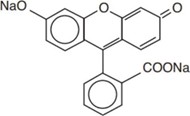
Fluorescein Injection, USP 500 mg/5 mL (100 mg/mL) 10% contains:
- Active ingredient: fluorescein sodium (10% w/v, 100 mg/mL), equivalent to 88.3 mg/mL of fluorescein
- Inactive ingredients: sodium hydroxide and/or hydrochloric acid may be used to adjust pH (8.3 to 9.8), and Water for Injection.
-
12 CLINICAL PHARMACOLOGY
12.1 Mechanism of Action
Fluorescein sodium responds to electromagnetic radiation and light between the wavelengths of 465 to 490 nm and fluoresces, i.e., emits light at wavelengths of 520 to 530 nm. Thus, the hydrocarbon is excited by blue light and emits light that appears yellowish green. Following intravenous injection of fluorescein sodium in an aqueous solution, the unbound fraction of the fluorescein can be excited with a blue light flash from a fundus camera as it circulates through the ocular vasculature, and the yellowish green fluorescence of the dye is captured by the camera. In the fundus, the fluorescence of the dye demarcates the retinal and/or choroidal vasculature under observation, distinguishing it from adjacent areas/structures.
12.3 Pharmacokinetics
Distribution.
Within 7 to 14 seconds after IV administration into the antecubital vein, fluorescein usually appears in the central retinal artery of the eye. Within a few minutes of IV administration of fluorescein sodium, a yellowish discoloration of the skin occurs, which begins to fade 6 to 12 hours after dosing. Various estimates of volume of distribution indicate that fluorescein distributes into interstitial space (0.5 L/kg).
Metabolism.
Fluorescein is metabolized to fluorescein monoglucuronide. After IV administration of fluorescein sodium (14 mg/kg) to 7 healthy subjects, approximately 80% of fluorescein in plasma was converted to glucuronide conjugate after a period of 1 hour post dose.
Excretion.
Fluorescein and its metabolite are mainly eliminated via renal excretion. After IV administration, the urine remains slightly fluorescent for 24 to 36 hours. A renal clearance of 1.75 mL/min/kg and a hepatic clearance (due to conjugation) of 1.50 mL/min/kg have been estimated. The systemic clearance of fluorescein was essentially complete by 48 to 72 hours after administration of 500 mg fluorescein.
- 13 NONCLINICAL TOXICOLOGY
-
16 HOW SUPPLIED/STORAGE AND HANDLING
Fluorescein Injection, USP 10%, 500 mg/5 mL (100 mg/mL) of fluorescein sodium is a dark reddish orange, clear solution in a single-dose vial.
(NDC: 54288-179-10) 5 mL, single dose vials in a package of 10.
Store fluorescein injection at 20°C to 25°C (68°F to 77°F) [See USP Controlled Room Temperature]. Do not freeze. Discard unused portion. -
17 PATIENT COUNSELING INFORMATION
After administration of fluorescein sodium, skin will attain a temporary yellowish discoloration. Urine attains a bright yellow color. Discoloration of the skin usually fades in 6 to 12 hours and usually fades in urine in 24 to 36 hours. [see Warnings and Precautions (6.1)].
Rx onlyManufactured by:
BPI Labs, LLC
12393 Belcher Road S, Suite 450
Largo, FL 33773 USALI69I
R-2605
Revised: May 2026 -
Principal Display Panel – Carton Label
Principal Display Panel – 5 mL Carton Label
NDC: 54288-179-10
Rx Only
Fluorescein Injection, USP 10%
500 mg/5 mL (100 mg/mL) / 10x5 mL sterile Single-dose Vials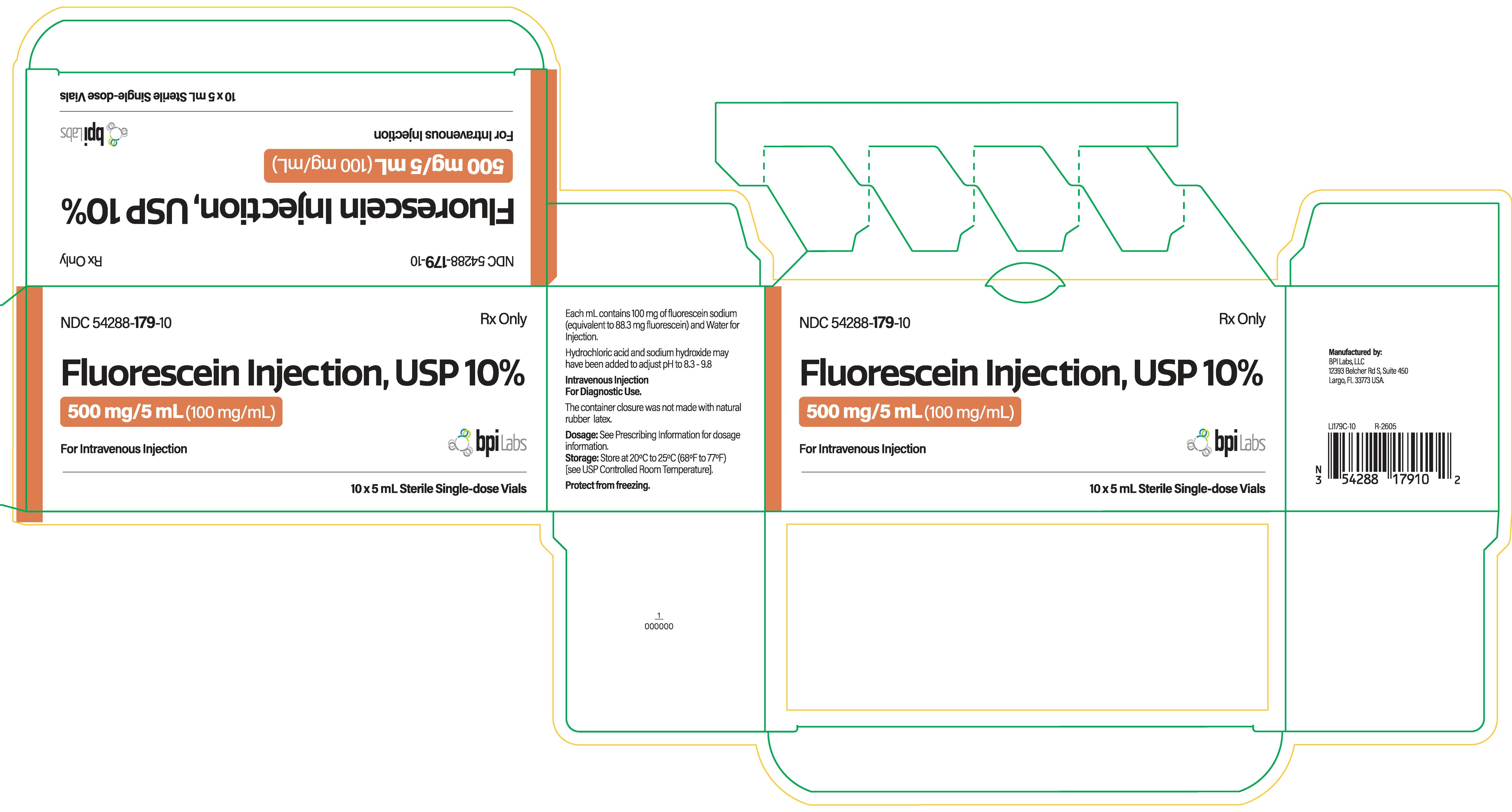
-
Principal Display Panel – Container Label
Principal Display Panel – 5 mL Label
NDC: 54288-179-01
Rx Only
Fluorescein Injection, USP 10% 500 mg/5 mL (100 mg/mL)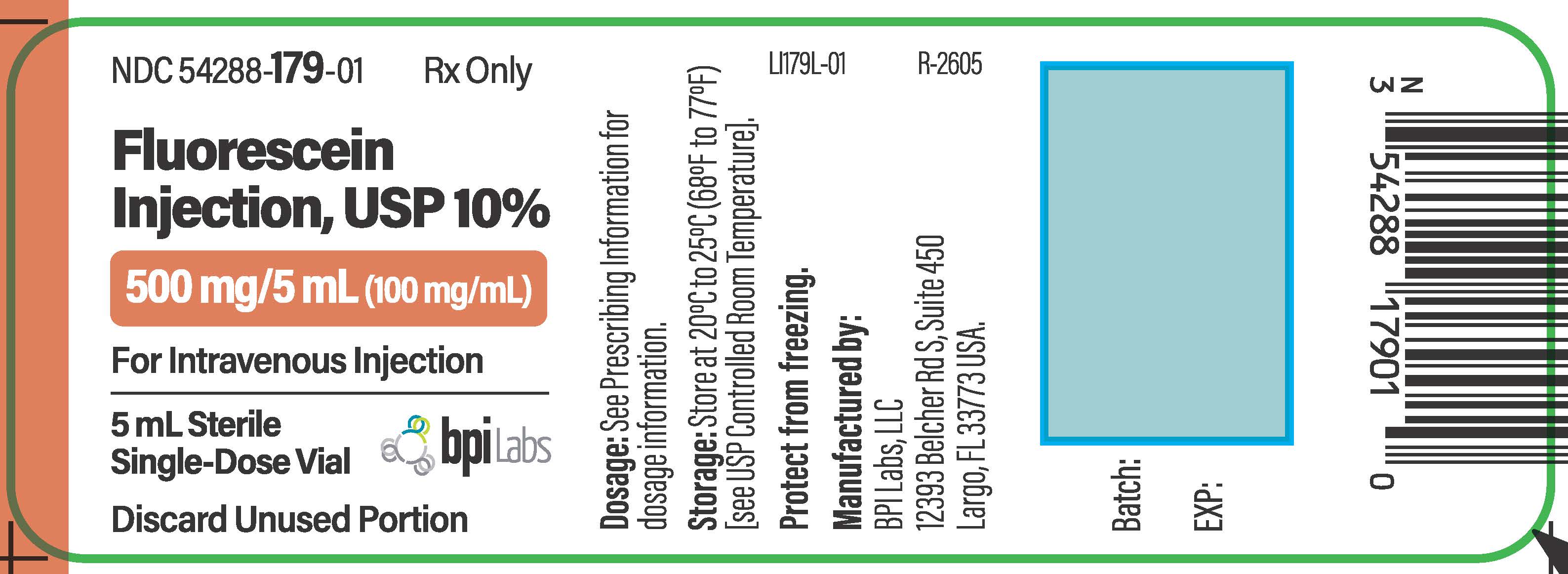
-
INGREDIENTS AND APPEARANCE
FLUORESCEIN
fluorescein injection, solutionProduct Information Product Type HUMAN PRESCRIPTION DRUG Item Code (Source) NDC: 54288-179 Route of Administration INTRAVENOUS Active Ingredient/Active Moiety Ingredient Name Basis of Strength Strength fluorescein sodium (UNII: 93X55PE38X) (fluorescein - UNII:TPY09G7XIR) fluorescein sodium 500 mg in 5 mL Inactive Ingredients Ingredient Name Strength sodium hydroxide (UNII: 55X04QC32I) hydrochloric acid (UNII: QTT17582CB) water (UNII: 059QF0KO0R) Packaging # Item Code Package Description Marketing Start Date Marketing End Date 1 NDC: 54288-179-10 10 in 1 CARTON 05/20/2026 1 NDC: 54288-179-01 5 mL in 1 VIAL, GLASS; Type 0: Not a Combination Product Marketing Information Marketing Category Application Number or Monograph Citation Marketing Start Date Marketing End Date ANDA ANDA220046 05/20/2026 Labeler - BPI Labs LLC (078627620) Registrant - BPI Labs LLC (078627620) Establishment Name Address ID/FEI Business Operations BPI Labs LLC 078627620 analysis(54288-179) , manufacture(54288-179)
© 2026 FDA.report
This site is not affiliated with or endorsed by the FDA.