Methenamine mandelate, USP is indicated for the suppression or elimination of bacteriuria associated with pyelonephritis, cystitis, and other chronic urinary tract infections; also for infected residual urine sometimes accompanying neurologic diseases. When used as recommended, methenamine mandelate, USP is particularly suitable for long-term therapy because of its safety and because resistance to the nonspecific ...
Dosage and administration
The average adult dose is 4 g daily given as 2 teaspoon after each meal and at bedtime. Children 6 to 12 should receive half the adult dose, and children under 6 years of age should receive 250 mg per 30 lb body weight, four times daily. Since an acid urine is essential for antibacterial activity, with maximum efficacy occurring at pH 5.5 or below, restriction of alkalinizing foods and medication is thus desirable...
Methenamine mandelate, USP, a urinary antibacterial agent, is the chemical combination of mandelic acid with methenamine. Methenamine mandelate, USP is available for oral use as oral liquid.
Each 5 mL (teaspoon) contains 500 mg Methenamine Mandelate. The oral solution also contains Sodium Saccharine, Benzyl Alcohol, Xanthan Gum, Mixed Berry Flavor and Water for Injection.
CLINICAL PHARMACOLOGY
CLINICAL PHARMACOLOGY SECTION
Methenamine mandelate, USP is readily absorbed but remains essentially inactive until it is excreted by the kidney and concentrated in the urine. An acid urine is essential for antibacterial action, with maximum efficacy occurring at pH 5.5 or less. In an acid urine, mandelic acid exerts its antibacterial action and also contributes to the acidification of the urine. Mandelic acid is excreted both by glomerular filtration and tubular excretion. The methenamine component, in an acid urine, is hydrolyzed to ammonia and to the bactericidal agent formaldehyde. There is equally effective antibacterial activity against both gram-positive and gram-negative organisms, since the antibacterial action of mandelic acid and formaldehyde is nonspecific. There are reports that methenamine mandelate, USP is ineffective in some infections with
Proteus vulgarisand urea-splitting strains of
Pseudomonas aeruginosaand
A aerogenes. Since urea-splitting strains may raise the pH of the urine, particular attention to supplementary acidification is required. However, results in any single case will depend to a large extent on the underlying pathology and the overall management.
INDICATIONS AND USAGE
INDICATIONS & USAGE SECTION
Methenamine mandelate, USP is indicated for the suppression or elimination of bacteriuria associated with pyelonephritis, cystitis, and other chronic urinary tract infections; also for infected residual urine sometimes accompanying neurologic diseases. When used as recommended, methenamine mandelate, USP is particularly suitable for long-term therapy because of its safety and because resistance to the nonspecific
bactericidal action of formaldehyde does not develop. Pathogens resistant to other antibacterial agents may respond to methenamine mandelate, USP because of the nonspecific effect of formaldehyde formed in an acid urine.
Prophylactic Use Rationale:Urine is a good culture medium for many urinary pathogens. Inoculation by a few organisms (relapse or reinfection) may lead to bacteriuria in susceptible individuals. Thus, the rationale of management in recurring urinary tract infection (bacteriuria) is to change the urine from a growth-supporting to a growth-inhibiting medium. There is a growing body of evidence that long-term administration of methenamine mandelate, USP can prevent the recurrence of bacteriuria in patients with chronic pyelonephritis.
T
herapeutic Use Rationale:Methenamine mandelate, USP helps to sterilize the urine, and in some situations in which underlying pathologic conditions prevent sterilization by any means, it can help to suppress the bacteriuria. Methenamine mandelate, USP should not be used alone for acute infections with parenchymal involvement causing systemic symptoms such as chi ls and fever. A thorough diagnostic investigation as a part of the overall management of the urinary tract infection should accompany the use of methenamine mandelate, USP.
CONTRAINDICATIONS
CONTRAINDICATIONS SECTION
Contraindicated in renal insufficiency.
Methenamine mandelate, USP should not be used in patients who have previously exhibited hypersensitivity to it.
PRECAUTIONS
PRECAUTIONS SECTION
GENERAL PRECAUTIONS
SPL UNCLASSIFIED SECTION
Dysuria may occur (usually at higher than recommended dosage). This can be controlled by reducing the dosage and the acidification. When urine acidification is contraindicated or unattainable (as with some urea-splitting bacteria), the drug is not recommended.
DRUG INTERACTIONS
DRUG INTERACTIONS SECTION
Formaldehyde and sulfamethizole form an insoluble precipitate in acid urine; therefore, methenamine mandelate, USP should not be administered concurrently with sulfamethizole.
DRUG & OR LABORATORY TEST INTERACTIONS
DRUG & OR LABORATORY TEST INTERACTIONS SECTION
Formaldehyde interferes with fluorometric procedures for determination of urinary catecholamines and vani lylmandelic acid (VMA), causing erroneously high results. Formaldehyde also causes falsely decreased urine estriol levels by reacting with estriol when acid hydrolysis techniques are used; estriol determinations which use enzymatic hydrolysis are unaffected by formaldehyde. Formaldehyde causes falsely elevated 17-
hydroxycorticosteroid levels when the Porter-Silber method is used and falsely decreased 5-hydroxyindoleacetic acid (5HIAA) levels by inhibiting color development when nitrosonaphthol methods are used.
PREGNANCY
PREGNANCY SECTION
Pregnancy Category C: Animal reproduction studies have not been conducted with methenamine mandelate, USP. It is also not known whether methenamine mandelate, USP can cause fetal harm when administered to a pregnant woman or can affect reproduction capacity. Methenamine mandelate, USP should be given to a pregnant woman only if clearly needed. Since introduction, published reports on the use of methenamine mandelate, USP in pregnant women have not shown an increased risk of fetal abnormalities from use during pregnancy.
ADVERSE REACTIONS
ADVERSE REACTIONS SECTION
An occasional patient may experience gastrointestinal disturbance or a generalized skin rash. Microscopic and rarely gross hematuria have been described.
DOSAGE AND ADMINISTRATION
DOSAGE & ADMINISTRATION SECTION
The average adult dose is 4 g daily given as 2 teaspoon after each meal and at bedtime. Children 6 to 12 should receive half the adult dose, and children under 6 years of age should receive 250 mg per 30 lb body weight, four times daily. Since an acid urine is essential for antibacterial activity, with maximum efficacy occurring at pH 5.5 or below, restriction of alkalinizing foods and medication is thus desirable. If testing of urine pH reveals the need, supplemental acidification should be given.
HOW SUPPLIED
HOW SUPPLIED SECTION
Methenamine Mandelate Oral Solution, 500 mg/5 mL, is a clear solution and available in the following oral dosage forms:
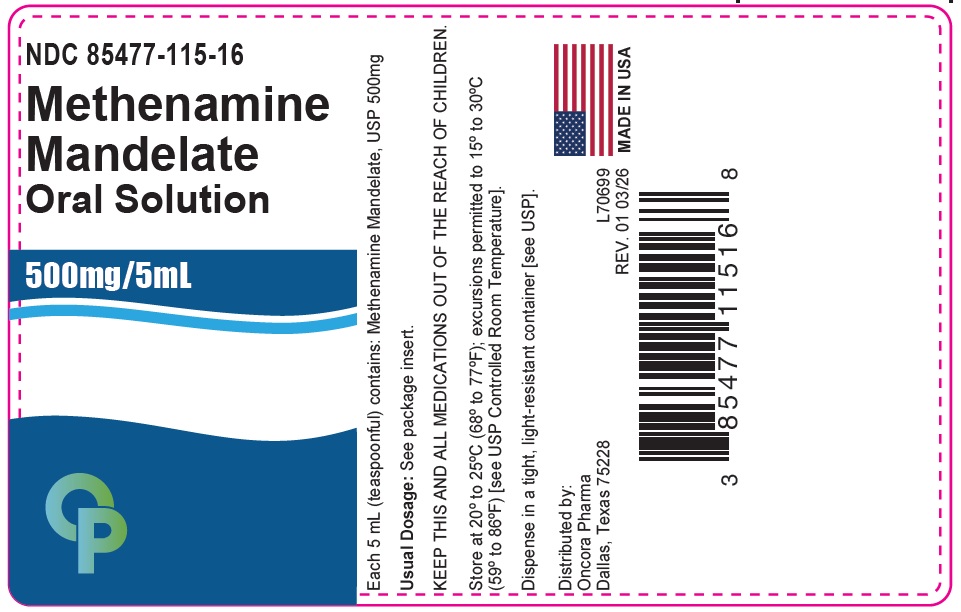
NDC 85477-115-16: 16 fl oz (473 mL) bottle
Store at controlled room temperature between 20°-25°C (68°-77°F);
excursions permitted to 15°-30°C (59°-86°F) [See USP controlled Room Temperature].
Dispense in a tight, light-resistant container as defined in the USP.
PACKAGE LABEL.PRINCIPAL DISPLAY PANEL
PACKAGE/LABEL PRINCIPAL DISPLAY PANEL
NDC 85477-115-16
Methenamine Mandelate Oral Solution - 500mg/5mL
Each 5 mL (teaspoonful) contains: Methenamine Mandelate, USP 500mg
Usual Dosage: See package insert
KEEP THIS AND ALL MEDICATIONS OUT OF THE REACH OF CHILDREN.
Dispense in a tight, light-resistant container [see USP].
OpenFDA label data provides additional search and identifier links. DailyMed’s Structured Product Label is the canonical label on FDA.report. Matching records are deduplicated before they are shown below.