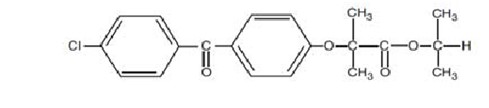
Fenofibrate is a pro-drug of the active chemical moiety fenofibric acid. Fenofibrate is converted by ester hydrolysis in the body to fenofibric acid which is the active constituent measurable in the circulation.
Absorption
The absolute bioavailability of fenofibrate cannot be determined as the compound is virtually insoluble in aqueous media suitable for injection. Fenofibrate is insoluble in water and its bioavailability is optimized when taken with meals. However, after fenofibrate is dissolved, fenofibrate is well absorbed from the gastrointestinal tract. Peak plasma levels of fenofibric acid from fenofibrate occur within 4 to 8 hours after administration. There was less than dose-proportional increase in the systemic exposure of fenofibric acid from 43 mg and 130 mg of fenofibrate under fasting conditions.
Doses of three-capsules of 43 mg fenofibrate given concurrently were dose equivalent to single-capsule doses of 130 mg.
Effect of Food
The extent of absorption of fenofibric acid was unaffected when fenofibrate was taken either in fasted state or with a low-fat meal. However, the C
maxof fenofibrate increased in the presence of a low-fat meal. T
maxwas unaffected in the presence of a low-fat meal. In the presence of a high-fat meal, there was a 26% increase in AUC and 108% increase in C
maxof fenofibric acid from fenofibrate relative to fasting state.
Distribution
In healthy volunteers, steady-state plasma levels of fenofibric acid were shown to be achieved within a week of dosing and did not demonstrate accumulation across time following multiple dose administration. Serum protein binding was approximately 99% in normal and hyperlipidemic subjects.
Elimination
Fenofibric acid is eliminated with a half-life of 23 hours, allowing once daily administration of fenofibrate
Metabolism
Following oral administration, fenofibrate is rapidly hydrolyzed by esterases to the active metabolite, fenofibric acid; no unchanged fenofibrate is detected in plasma. Fenofibric acid is primarily conjugated with glucuronic acid and then excreted in urine. A small amount of fenofibric acid is reduced at the carbonyl moiety to a benzhydrol metabolite which is, in turn, conjugated with glucuronic acid and excreted in urine.
In vivometabolism data indicate that neither fenofibrate nor fenofibric acid undergo oxidative metabolism (e.g., cytochrome P450) to a significant extent.
Excretion
After absorption, fenofibrate is mainly excreted in the urine in the form of metabolites, primarily fenofibric acid and fenofibric acid glucuronide. After administration of radio-labeled fenofibrate, approximately 60% of the dose appeared in the urine and 25% was excreted in the feces.
Specific Populations
Geriatric Patients
In geriatric volunteers 77 to 87 years of age, the apparent oral clearance of fenofibric acid following a single oral dose of fenofibrate was 1.2 L/h, which compares to 1.1 L/h in young adults. This indicates that a similar dosage regimen can be used in geriatric patients with normal renal function, without increasing accumulation of the drug or metabolites
[see Dosage and Administration (2.4)
and
Use in Specific Populations (8.5)].
Pediatric Patients
The pharmacokinetics of fenofibrate has not been studied in pediatric populations.
Male and Female Patients
No pharmacokinetic difference between males and females has been observed for fenofibrate.
Racial or Ethnic Groups
The influence of race on the pharmacokinetics of fenofibrate has not been studied however fenofibrate is not metabolized by enzymes known for exhibiting inter-ethnic variability.
Patients withRenal Impairment
The pharmacokinetics of fenofibric acid were examined in patients with mild, moderate and severe renal impairment. Patients with severe renal impairment (creatinine clearance [CrCl ≤ 30 mL/min] or estimated glomerular filtration rate [eGFR] < 30 mL/min/1.73m
2) showed a 2.7-fold increase in exposure for fenofibric acid and increased accumulation of fenofibric acid during chronic dosing compared to that of healthy subjects. Patients with mild to moderate renal impairment (CrCl 30 mL/min to 80 mL/min or eGFR 30 to 59 mL/min/1.73m
2) had similar exposure but an increase in the half-life for fenofibric acid compared to that of healthy subjects. Based on these findings, the use of fenofibrate is contraindicated in patients with severe renal impairment, including end-stage renal disease (ESRD) or those receiving dialysis. Dose reduction is required in patients having mild to moderate renal impairment
[see Dosage and Administration (2.4)].
Patients withHepatic Impairment
No pharmacokinetic studies have been conducted in patients with hepatic impairment.
Drug Interaction Studies
In vitrostudies using human liver microsomes indicate that fenofibrate and fenofibric acid are not inhibitors of cytochrome (CYP) P450 isoforms CYP3A4, CYP2D6, CYP2E1, or CYP1A2. They are weak inhibitors of CYP2C8, CYP2C19 and CYP2A6, and mild to moderate inhibitors of CYP2C9 at therapeutic concentrations.
Table 3 describes the effects of co-administered drugs on fenofibric acid systemic exposure. Table 4 describes the effects of co-administered fenofibrate or fenofibric acid on systemic exposure of other drugs.
Table 3: Effects of Co-Administered Drugs on Fenofibric Acid Systemic Exposure from Fenofibrate Administration
Co-Administered Drug | Dosage Regimen of Co- Administered Drug | Dosage Regimen of Fenofibrate | Changes in Fenofibric Acid Exposure |
AUC | C
max
|
Lipid-lowering medications |
Atorvastatin | 20 mg once daily for 10 days | Fenofibrate 160 mg
1once daily for 10 days
| ↓2% | ↓4% |
Pravastatin | 40 mg as a single dose | Fenofibrate 3 x 67 mg
2as a single dose
| ↓1% | ↓2% |
Fluvastatin | 40 mg as a single dose | Fenofibrate 160 mg
1as a single dose
| ↓2% | ↓10% |
Anti-diabetic medications |
Glimepiride | 1 mg as a single dose | Fenofibrate 145 mg
1once daily for 10 days
| ↑1% | ↓1% |
Metformin | 850 mg three times daily for 10 days | Fenofibrate 54 mg
1three times daily for 10 days
| ↓9% | ↓6% |
Rosiglitazone | 8 mg once daily for 5 days | Fenofibrate 145 mg
1once daily for 14 days
| ↑10% | ↑3% |
1Fenofibrate oral tablet
2Fenofibrate oral micronized capsule
Table 4: Effects of Fenofibrate Co-Administration on Systemic Exposure ofOtherDrugs
Dosage Regimen of Fenofibrate | Dosage Regimen of Co-Administered Drug | Changes in Co-Administered Drug Exposure |
Analyte | AUC | C
max
|
Lipid-lowering medications |
Fenofibrate 160 mg
1once daily for 10 days
| Atorvastatin, 20 mg once daily for 10 days | Atorvastatin | ↓17% | 0% |
Fenofibrate 3 x 67 mg
2as a single dose
| Pravastatin, 40 mg as a single dose | Pravastatin | ↑13% | ↑13% |
3α-Hydroxyl-iso- pravastatin | ↑26% | ↑29% |
Fenofibrate 160 mg
1as a single dose
| Fluvastatin, 40 mg as a single dose | (+)-3R, 5S-Fluvastatin | ↑15% | ↑16% |
Anti-diabetic medications |
Fenofibrate 145 mg
1once daily for 10 days
| Glimepiride, 1 mg as a single dose | Glimepiride | ↑35% | ↑18% |
Fenofibrate 54 mg
1three times daily for 10 days
| Metformin, 850 mg three times daily for 10 days | Metformin | ↑3% | ↑6% |
Fenofibrate 145 mg
1once daily for 14 days
| Rosiglitazone, 8 mg once daily for 5 days | Rosiglitazone | ↑6% | ↓1% |
1Fenofibrate oral tablet
2Fenofibrate oral micronized capsule