Indications and uses
Potassium Chloride for Injection Concentrate, USP is indicated in the treatment of potassium deficiency states when oral replacement is not feasible.
Potassium Chloride for Injection Concentrate, USP is indicated in the treatment of potassium deficiency states when oral replacement is not feasible.
Potassium Chloride for Injection Concentrate, USP must be diluted before administration. Care must be taken to ensure there is complete mixing of the potassium chloride with the large volume fluid, particularly if soft or bag type containers are used. The dose and rate of administration are dependent upon the specific condition of each patient. If the serum potassium level is greater than 2.5 mEq/liter, potassium ...
for Injection
Concentrate, USP

FOR INTRAVENOUS INFUSION ONLY;
MUST BE DILUTED PRIOR TO INJECTION.
Fliptop Vials
Potassium Chloride for Injection Concentrate, USP, is a sterile, nonpyrogenic, concentrated solution of potassium chloride, USP in water for injection administered by intravenous infusion only after dilution in a larger volume of fluid. They are provided in the following variety of concentrations and sizes comprising a choice of single-dose containers, all designed to provide the commonly prescribed amounts of potassium chloride for single-dose infusion after dilution in suitable large volume parenterals.
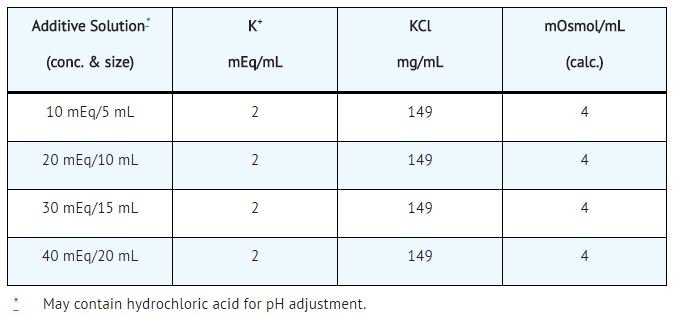
The solutions contain no bacteriostat, antimicrobial agent or added buffer (except for pH adjustment) and each is intended only for single-dose injection (after dilution). When smaller doses are required, discard the unused portion. The pH is 4.6 (4.0 to 8.0).
Potassium Chloride for Injection Concentrate, USP (appropriately diluted) is a parenteral fluid and electrolyte replenisher.
Potassium Chloride, USP is chemically designated KCl, a white granular powder freely soluble in water.
The semi-rigid material used for the plastic vials is fabricated from a specially formulated polyolefin. It is a copolymer of ethylene and propylene. The safety of the plastic has been confirmed by tests in animals according to USP biological standards for plastic containers. The container requires no vapor barrier to maintain the proper drug concentration.
Potassium is the chief cation of body cells (160 mEq/liter of intracellular water) and is concerned with the maintenance of body fluid composition and electrolyte balance. Potassium participates in carbohydrate utilization and protein synthesis, and is critical in the regulation of nerve conduction and muscle contraction, particularly in the heart. Chloride, the major extracellular anion, closely follows the metabolism of sodium, and changes in the acid-base balance of the body are reflected by changes in the chloride concentration.
Normally about 80 to 90% of the potassium intake is excreted in the urine, the remainder in the stools and, to a small extent, in perspiration. The kidney does not conserve potassium well so that during fasting, or in patients on a potassium-free diet, potassium loss from the body continues, resulting in potassium depletion. A deficiency of either potassium or chloride will lead to a deficit of the other.
Potassium Chloride for Injection Concentrate, USP is indicated in the treatment of potassium deficiency states when oral replacement is not feasible.
Potassium Chloride for Injection Concentrate, USP is contraindicated in diseases where high potassium levels may be encountered, and in patients with hyperkalemia, renal failure and in conditions in which potassium retention is present.
To avoid potassium intoxication, do not infuse solutions rapidly. In patients with severe renal insufficiency, administration of potassium chloride may cause potassium intoxication and life threatening hyperkalemia.
The administration of intravenous solutions can cause fluid and/or solute overload resulting in dilution of serum electrolyte concentrations, overhydration, congested states or pulmonary edema.
The risk of dilutional states is inversely proportional to the electrolyte concentration. The risk of solute overload causing congested states with peripheral and pulmonary edema is directly proportional to the electrolyte concentration.
WARNING: This product contains aluminum that may be toxic. Aluminum may reach toxic levels with prolonged parenteral administration if kidney function is impaired. Premature neonates are particularly at risk because their kidneys are immature, and they require large amounts of calcium and phosphate solutions, which contain aluminum.
Research indicates that patients with impaired kidney function, including premature neonates, who receive parenteral levels of aluminum at greater than 4 to 5 mcg/kg/day accumulate aluminum at levels associated with central nervous system and bone toxicity. Tissue loading may occur at even lower rates of administration.
General
Clinical evaluation and periodic laboratory determinations are necessary to monitor changes in fluid balance, electrolyte concentrations, and acid-base balance during prolonged parenteral therapy or whenever the condition of the patient warrants such evaluation. Significant deviations from normal concentrations may require the use of additional electrolyte supplements, or the use of electrolyte-free dextrose solutions to which individualized electrolyte supplements may be added.
Potassium therapy should be guided primarily by serial electrocardiograms, especially in patients receiving digitalis. Serum potassium levels are not necessarily indicative of tissue potassium levels. Solutions containing potassium should be used with caution in the presence of cardiac disease, particularly in the presence of renal disease, and in such instances, cardiac monitoring is recommended.
Solutions containing dextrose should be used with caution in patients with overt or known subclinical diabetes mellitus, or carbohydrate intolerance for any reason.
If the administration is controlled by a pumping device, care must be taken to discontinue pumping action before the container runs dry or air embolism may result.
Pregnancy
Teratogenic Effects: Animal reproduction studies have not been conducted with potassium chloride. It is also not known whether potassium chloride can cause fetal harm when administered to a pregnant woman or can affect reproduction capacity. Potassium chloride should be given to a pregnant woman only if clearly needed.
Reactions which may occur because of the solution or the technique of administration include febrile response, infection at the site of injection, venous thrombosis or phlebitis extending from the site of injection, extravasation, hypervolemia, and hyperkalemia.
Too rapid infusion of hypertonic solutions may cause local pain and, rarely, vein irritation. Rate of administration should be adjusted according to tolerance.
Reactions reported with the use of potassium-containing solutions include nausea, vomiting, abdominal pain and diarrhea. The signs and symptoms of potassium intoxication include paresthesias of the extremities, areflexia, muscular or respiratory paralysis, mental confusion, weakness, hypotension, cardiac arrhythmias, heart block, electrocardiographic abnormalities and cardiac arrest. Potassium deficits result in disruption of neuromuscular function, and intestinal ileus and dilatation.
If an adverse reaction does occur, discontinue the infusion, evaluate the patient, institute appropriate therapeutic countermeasures and save the remainder of the fluid for examination if deemed necessary.
In the event of fluid overload during parenteral therapy, re-evaluate the patient's condition, and institute appropriate corrective treatment.
In the event of overdosage with potassium-containing solutions, discontinue the infusion immediately, and institute corrective therapy to reduce serum potassium levels.
Treatment of hyperkalemia includes the following:
1.
Dextrose Injection USP, 10% or 25%, containing 10 units of crystalline insulin per 20 grams of dextrose administered intravenously, at a rate of 300 to 500 mL per hour.
2.
Absorption and exchange of potassium using sodium or ammonium cycle cation exchange resin, orally and as retention enema.
3.
Hemodialysis and peritoneal dialysis. The use of potassium-containing foods or medications must be eliminated. However, in cases of digitalization, too rapid a lowering of plasma potassium concentration can cause digitalis toxicity.
Potassium Chloride for Injection Concentrate, USP must be diluted before administration. Care must be taken to ensure there is complete mixing of the potassium chloride with the large volume fluid, particularly if soft or bag type containers are used.
The dose and rate of administration are dependent upon the specific condition of each patient.
If the serum potassium level is greater than 2.5 mEq/liter, potassium can be given at a rate not to exceed 10 mEq/hour in a concentration of up to 40 mEq/liter. The 24-hour total dose should not exceed 200 mEq.
If urgent treatment is indicated (serum potassium level less than 2.0 mEq/liter with electrocardiographic changes and/or muscle paralysis) potassium chloride may be infused very cautiously at a rate of up to 40 mEq/hour. In such cases, continuous cardiac monitoring is essential. As much as 400 mEq may be administered in a 24 hour period. In critical conditions, potassium chloride may be administered in saline (unless contraindicated), rather than in dextrose containing fluids, as dextrose may lower serum potassium levels.
Prior to entering vial, remove the metal seal and cleanse the rubber closure with a suitable antiseptic agent.
Parenteral drug products should be inspected visually for particulate matter and discoloration, whenever solution and container permit.
TO PREVENT NEEDLE-STICK INJURIES, NEEDLES SHOULD NOT BE RECAPPED, PURPOSELY BENT, OR BROKEN BY HAND.
Potassium Chloride for Injection Concentrate, USP, is supplied in single-dose containers as follows:
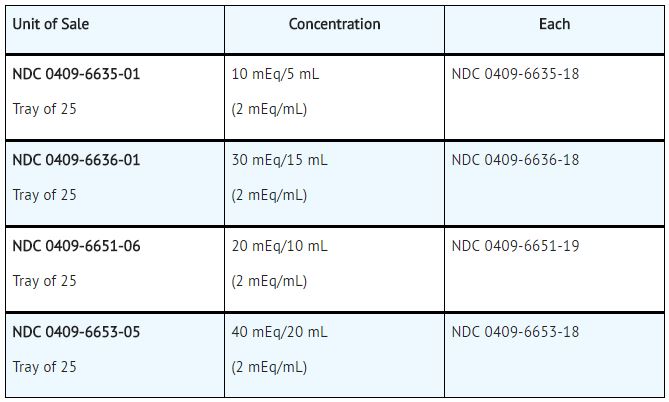
Store at 20 to 25°C (68 to 77°F). [See USP Controlled Room Temperature.]
Distributed by Hospira Inc., Lake Forest, IL 60045 USA
Hospira
LAB-1319-1.0
Revised: 5/2018

| Package NDC | Billing unit | Product NDC | DailyMed indexing SPL | SPL version | Effective |
|---|---|---|---|---|---|
| 0409-6651-06 | ML - Milliliter | 0409-6651 | dbc4bd82-51ab-441b-a4a0-4604ec6970d4 | 1 | 2012-07-24 |
| 0409-6651-19 | ML - Milliliter | 0409-6651 | 6ee9d680-f462-4974-88e2-fe65b215ef10 | 1 | 2015-04-03 |
| Ingredient | Type | UNII | SPL version | Uploaded |
|---|---|---|---|---|
| POTASSIUM CHLORIDE | ACTIVE INGREDIENT | 660YQ98I10 | 1 | |
| POTASSIUM CATION | ACTIVE MOIETY | 295O53K152 | 1 | |
| HYDROCHLORIC ACID | INACTIVE INGREDIENT | QTT17582CB | 1 | |
| WATER | INACTIVE INGREDIENT | 059QF0KO0R | 1 |
Every source-derived product name is available through these pages.
| Product NDC | Package NDC |
|---|---|
| 52584-651 | 52584-651-06 |
| 0409-6651 |
Every source-derived ingredient row is available through these pages.
| Name | UNII | Kind |
|---|---|---|
| POTASSIUM CHLORIDE | 660YQ98I10 | ACTIB |
| WATER | 059QF0KO0R | IACT |
| HYDROCHLORIC ACID | QTT17582CB | IACT |
Inactive Ingredient Database values describe FDA-listed use contexts. The match method and ambiguity count are shown because ingredient names, routes, and dosage forms are not always unique. Browse recovered IID releases and source provenance.
| DailyMed ingredient | IID ingredient | UNII | Dosage form / route | Potency | Maximum daily exposure | Match |
|---|---|---|---|---|---|---|
| HYDROCHLORIC ACID | HYDROCHLORIC ACID | QTT17582CB | LIQUID / INTRAVENOUS | ADJ PH | ||
| HYDROCHLORIC ACID | HYDROCHLORIC ACID | QTT17582CB | INJECTION, SOLUTION / INTRAVENOUS | 1037 mg | ||
| HYDROCHLORIC ACID | HYDROCHLORIC ACID | QTT17582CB | SOLUTION, CONCENTRATE / INTRAVENOUS | ADJ PH | ||
| HYDROCHLORIC ACID | HYDROCHLORIC ACID | QTT17582CB | INJECTION, POWDER, FOR SUSPENSION / INTRAVENOUS | 4.17 mg | ||
| HYDROCHLORIC ACID | HYDROCHLORIC ACID | QTT17582CB | INJECTION / INTRAVENOUS | 720 mg | ||
| HYDROCHLORIC ACID | HYDROCHLORIC ACID | QTT17582CB | POWDER / INTRAVENOUS | ADJ PH | ||
| HYDROCHLORIC ACID | HYDROCHLORIC ACID | QTT17582CB | SOLUTION / INTRAVENOUS | 18.25 mg | ||
| HYDROCHLORIC ACID | HYDROCHLORIC ACID | QTT17582CB | INJECTION, SUSPENSION, LIPOSOMAL / INTRAVENOUS | ADJ PH | ||
| HYDROCHLORIC ACID | HYDROCHLORIC ACID | QTT17582CB | INJECTION, POWDER, FOR SOLUTION / INTRAVENOUS | 0.18 %w/v | ||
| HYDROCHLORIC ACID | HYDROCHLORIC ACID | QTT17582CB | INJECTION, EMULSION / INTRAVENOUS | ADJ PH | ||
| HYDROCHLORIC ACID | HYDROCHLORIC ACID | QTT17582CB | INJECTABLE, LIPOSOMAL / INTRAVENOUS | ADJ PH | ||
| HYDROCHLORIC ACID | HYDROCHLORIC ACID | QTT17582CB | INJECTION, SUSPENSION / INTRAVENOUS | ADJ PH | ||
| HYDROCHLORIC ACID | HYDROCHLORIC ACID | QTT17582CB | INJECTION, POWDER, LYOPHILIZED, FOR SOLUTION / INTRAVENOUS | 160 mg |
All distinct exact application/product contexts derived from this label’s complete NDC list are paginated below.
| Application-product | Trade name | Ingredient | Strength | Dosage form / route | TE codes | RLD / RS | Approval date |
|---|---|---|---|---|---|---|---|
| A080205-001 | POTASSIUM CHLORIDE | POTASSIUM CHLORIDE | 2MEQ/ML | INJECTABLE / INJECTION | AP | RLD, RS, Approved before 1982 | |
| A080205-003 | POTASSIUM CHLORIDE | POTASSIUM CHLORIDE | 1MEQ/ML | INJECTABLE / INJECTION | Approved before 1982 | ||
| A080205-004 | POTASSIUM CHLORIDE | POTASSIUM CHLORIDE | 2.4MEQ/ML | INJECTABLE / INJECTION | Approved before 1982 | ||
| A080205-005 | POTASSIUM CHLORIDE | POTASSIUM CHLORIDE | 3.2MEQ/ML | INJECTABLE / INJECTION | Approved before 1982 |
| Application-product | TE code |
|---|---|
| A080205-001 | AP |
Observed FDA ZIP history: Each table is queried independently by exact application/product key from successfully parsed Orange Book snapshots. Capture times identify archived source observations; absence or a change between snapshots is not inferred. FDA publication files that were not recoverable as structured ZIP data are not represented as states.
| Captured | Edition | Application-product | Trade name | Strength | Dosage form / route | Product TE source text | RLD / RS | Approval date | Source SHA-256 |
|---|---|---|---|---|---|---|---|---|---|
| 2026-10-15 13:18:30 | 2026-09 | A080205-001 | POTASSIUM CHLORIDE | 2MEQ/ML | INJECTABLE / INJECTION | AP | RLD, RS, Approved before 1982 | c2088c7a36db… | |
| 2026-10-15 13:18:30 | 2026-09 | A080205-003 | POTASSIUM CHLORIDE | 1MEQ/ML | INJECTABLE / INJECTION | Approved before 1982 | c2088c7a36db… | ||
| 2026-10-15 13:18:30 | 2026-09 | A080205-004 | POTASSIUM CHLORIDE | 2.4MEQ/ML | INJECTABLE / INJECTION | Approved before 1982 | c2088c7a36db… | ||
| 2026-10-15 13:18:30 | 2026-09 | A080205-005 | POTASSIUM CHLORIDE | 3.2MEQ/ML | INJECTABLE / INJECTION | Approved before 1982 | c2088c7a36db… | ||
| 2026-09-14 22:38:34 | 2026-08 | A080205-001 | POTASSIUM CHLORIDE | 2MEQ/ML | INJECTABLE / INJECTION | AP | RLD, RS, Approved before 1982 | 84e616aacf4f… | |
| 2026-09-14 22:38:34 | 2026-08 | A080205-003 | POTASSIUM CHLORIDE | 1MEQ/ML | INJECTABLE / INJECTION | Approved before 1982 | 84e616aacf4f… | ||
| 2026-09-14 22:38:34 | 2026-08 | A080205-004 | POTASSIUM CHLORIDE | 2.4MEQ/ML | INJECTABLE / INJECTION | Approved before 1982 | 84e616aacf4f… | ||
| 2026-09-14 22:38:34 | 2026-08 | A080205-005 | POTASSIUM CHLORIDE | 3.2MEQ/ML | INJECTABLE / INJECTION | Approved before 1982 | 84e616aacf4f… | ||
| 2026-08-18 06:07:40 | 2026-07 | A080205-001 | POTASSIUM CHLORIDE | 2MEQ/ML | INJECTABLE / INJECTION | AP | RLD, RS, Approved before 1982 | caaa826d4ba7… | |
| 2026-08-18 06:07:40 | 2026-07 | A080205-003 | POTASSIUM CHLORIDE | 1MEQ/ML | INJECTABLE / INJECTION | Approved before 1982 | caaa826d4ba7… | ||
| 2026-08-18 06:07:40 | 2026-07 | A080205-004 | POTASSIUM CHLORIDE | 2.4MEQ/ML | INJECTABLE / INJECTION | Approved before 1982 | caaa826d4ba7… | ||
| 2026-08-18 06:07:40 | 2026-07 | A080205-005 | POTASSIUM CHLORIDE | 3.2MEQ/ML | INJECTABLE / INJECTION | Approved before 1982 | caaa826d4ba7… | ||
| 2026-02-19 14:30 UTC | 2026-02 | A080205-001 | POTASSIUM CHLORIDE | 2MEQ/ML | INJECTABLE / INJECTION | AP | RLD, RS, Approved before 1982 | 011fe1cb6892… | |
| 2026-02-19 14:30 UTC | 2026-02 | A080205-003 | POTASSIUM CHLORIDE | 1MEQ/ML | INJECTABLE / INJECTION | Approved before 1982 | 011fe1cb6892… | ||
| 2026-02-19 14:30 UTC | 2026-02 | A080205-004 | POTASSIUM CHLORIDE | 2.4MEQ/ML | INJECTABLE / INJECTION | Approved before 1982 | 011fe1cb6892… | ||
| 2026-02-19 14:30 UTC | 2026-02 | A080205-005 | POTASSIUM CHLORIDE | 3.2MEQ/ML | INJECTABLE / INJECTION | Approved before 1982 | 011fe1cb6892… | ||
| 2025-12-14 10:44 UTC · 2 captures of this ZIP | 2025-12 | A080205-001 | POTASSIUM CHLORIDE | 2MEQ/ML | INJECTABLE / INJECTION | AP | RLD, RS, Approved before 1982 | 31067a03dcf5… | |
| 2025-12-14 10:44 UTC · 2 captures of this ZIP | 2025-12 | A080205-003 | POTASSIUM CHLORIDE | 1MEQ/ML | INJECTABLE / INJECTION | Approved before 1982 | 31067a03dcf5… | ||
| 2025-12-14 10:44 UTC · 2 captures of this ZIP | 2025-12 | A080205-004 | POTASSIUM CHLORIDE | 2.4MEQ/ML | INJECTABLE / INJECTION | Approved before 1982 | 31067a03dcf5… | ||
| 2025-12-14 10:44 UTC · 2 captures of this ZIP | 2025-12 | A080205-005 | POTASSIUM CHLORIDE | 3.2MEQ/ML | INJECTABLE / INJECTION | Approved before 1982 | 31067a03dcf5… | ||
| 2025-08-23 18:47 UTC | 2025-08 | A080205-001 | POTASSIUM CHLORIDE | 2MEQ/ML | INJECTABLE / INJECTION | AP | RLD, RS, Approved before 1982 | 6a471c1ec25d… | |
| 2025-08-23 18:47 UTC | 2025-08 | A080205-003 | POTASSIUM CHLORIDE | 1MEQ/ML | INJECTABLE / INJECTION | Approved before 1982 | 6a471c1ec25d… | ||
| 2025-08-23 18:47 UTC | 2025-08 | A080205-004 | POTASSIUM CHLORIDE | 2.4MEQ/ML | INJECTABLE / INJECTION | Approved before 1982 | 6a471c1ec25d… | ||
| 2025-08-23 18:47 UTC | 2025-08 | A080205-005 | POTASSIUM CHLORIDE | 3.2MEQ/ML | INJECTABLE / INJECTION | Approved before 1982 | 6a471c1ec25d… | ||
| 2025-03-22 03:13 UTC · 3 captures of this ZIP | 2025-03 | A080205-001 | POTASSIUM CHLORIDE | 2MEQ/ML | INJECTABLE / INJECTION | AP | RLD, RS, Approved before 1982 | fd3edfee7708… | |
| 2025-03-22 03:13 UTC · 3 captures of this ZIP | 2025-03 | A080205-003 | POTASSIUM CHLORIDE | 1MEQ/ML | INJECTABLE / INJECTION | Approved before 1982 | fd3edfee7708… | ||
| 2025-03-22 03:13 UTC · 3 captures of this ZIP | 2025-03 | A080205-004 | POTASSIUM CHLORIDE | 2.4MEQ/ML | INJECTABLE / INJECTION | Approved before 1982 | fd3edfee7708… | ||
| 2025-03-22 03:13 UTC · 3 captures of this ZIP | 2025-03 | A080205-005 | POTASSIUM CHLORIDE | 3.2MEQ/ML | INJECTABLE / INJECTION | Approved before 1982 | fd3edfee7708… | ||
| 2025-02-26 10:13 UTC · 3 captures of this ZIP | 2025-02 | A080205-001 | POTASSIUM CHLORIDE | 2MEQ/ML | INJECTABLE / INJECTION | AP | RLD, RS, Approved before 1982 | b8a1b40f171c… | |
| 2025-02-26 10:13 UTC · 3 captures of this ZIP | 2025-02 | A080205-003 | POTASSIUM CHLORIDE | 1MEQ/ML | INJECTABLE / INJECTION | Approved before 1982 | b8a1b40f171c… | ||
| 2025-02-26 10:13 UTC · 3 captures of this ZIP | 2025-02 | A080205-004 | POTASSIUM CHLORIDE | 2.4MEQ/ML | INJECTABLE / INJECTION | Approved before 1982 | b8a1b40f171c… | ||
| 2025-02-26 10:13 UTC · 3 captures of this ZIP | 2025-02 | A080205-005 | POTASSIUM CHLORIDE | 3.2MEQ/ML | INJECTABLE / INJECTION | Approved before 1982 | b8a1b40f171c… | ||
| 2025-01-19 17:59 UTC · 7 captures of this ZIP | 2025-01 | A080205-001 | POTASSIUM CHLORIDE | 2MEQ/ML | INJECTABLE / INJECTION | AP | RLD, RS, Approved before 1982 | 03ed91905a0d… | |
| 2025-01-19 17:59 UTC · 7 captures of this ZIP | 2025-01 | A080205-003 | POTASSIUM CHLORIDE | 1MEQ/ML | INJECTABLE / INJECTION | Approved before 1982 | 03ed91905a0d… | ||
| 2025-01-19 17:59 UTC · 7 captures of this ZIP | 2025-01 | A080205-004 | POTASSIUM CHLORIDE | 2.4MEQ/ML | INJECTABLE / INJECTION | Approved before 1982 | 03ed91905a0d… | ||
| 2025-01-19 17:59 UTC · 7 captures of this ZIP | 2025-01 | A080205-005 | POTASSIUM CHLORIDE | 3.2MEQ/ML | INJECTABLE / INJECTION | Approved before 1982 | 03ed91905a0d… | ||
| 2024-12-13 21:23 UTC · 2 captures of this ZIP | 2024-12 | A080205-001 | POTASSIUM CHLORIDE | 2MEQ/ML | INJECTABLE / INJECTION | AP | RLD, RS, Approved before 1982 | 2680178bc6a6… | |
| 2024-12-13 21:23 UTC · 2 captures of this ZIP | 2024-12 | A080205-003 | POTASSIUM CHLORIDE | 1MEQ/ML | INJECTABLE / INJECTION | Approved before 1982 | 2680178bc6a6… | ||
| 2024-12-13 21:23 UTC · 2 captures of this ZIP | 2024-12 | A080205-004 | POTASSIUM CHLORIDE | 2.4MEQ/ML | INJECTABLE / INJECTION | Approved before 1982 | 2680178bc6a6… | ||
| 2024-12-13 21:23 UTC · 2 captures of this ZIP | 2024-12 | A080205-005 | POTASSIUM CHLORIDE | 3.2MEQ/ML | INJECTABLE / INJECTION | Approved before 1982 | 2680178bc6a6… |
| Captured | Edition | Application-product | TE code | Order | Source SHA-256 |
|---|---|---|---|---|---|
| 2026-10-15 13:18:30 | 2026-09 | A080205-001 | AP | 1 | c2088c7a36db… |
| 2026-09-14 22:38:34 | 2026-08 | A080205-001 | AP | 1 | 84e616aacf4f… |
| 2026-08-18 06:07:40 | 2026-07 | A080205-001 | AP | 1 | caaa826d4ba7… |
| 2026-02-19 14:30 UTC | 2026-02 | A080205-001 | AP | 1 | 011fe1cb6892… |
| 2025-12-14 10:44 UTC · 2 captures of this ZIP | 2025-12 | A080205-001 | AP | 1 | 31067a03dcf5… |
| 2025-08-23 18:47 UTC | 2025-08 | A080205-001 | AP | 1 | 6a471c1ec25d… |
| 2025-03-22 03:13 UTC · 3 captures of this ZIP | 2025-03 | A080205-001 | AP | 1 | fd3edfee7708… |
| 2025-02-26 10:13 UTC · 3 captures of this ZIP | 2025-02 | A080205-001 | AP | 1 | b8a1b40f171c… |
| 2025-01-19 17:59 UTC · 7 captures of this ZIP | 2025-01 | A080205-001 | AP | 1 | 03ed91905a0d… |
| 2024-12-13 21:23 UTC · 2 captures of this ZIP | 2024-12 | A080205-001 | AP | 1 | 2680178bc6a6… |
| 2024-09-14 05:58 UTC · 2 captures of this ZIP | 2024-09 | A080205-001 | AP | 1 | 5bbf6a4d5a75… |
| 2024-11-08 22:44 UTC · 3 captures of this ZIP | 2024-11 | A080205-001 | AP | 1 | d8e5a09893c0… |
| 2024-10-29 15:01 UTC | 2024-10 | A080205-001 | AP | 1 | d06236e962d9… |
| 2024-08-13 05:28 UTC · 3 captures of this ZIP | 2024-08 | A080205-001 | AP | 1 | 79d66fd596c7… |
| 2024-07-13 05:37 UTC · 2 captures of this ZIP | 2024-07 | A080205-001 | AP | 1 | 301d65b070ca… |
| 2024-06-18 03:08 UTC · 5 captures of this ZIP | 2024-06 | A080205-001 | AP | 1 | 1e350fbaab3a… |
| 2024-05-31 18:47 UTC | 2024-05 | A080205-001 | AP | 1 | 8072bd15b7f6… |
| 2022-06-29 02:47 UTC · 2 captures of this ZIP | 2022-06 | A080205-001 | AP | 1 | 5c6f7cd8ea54… |
| 2022-04-08 23:34 UTC | 2022-04 | A080205-001 | AP | 1 | 5d02ea3f76ae… |
| 2022-04-04 05:41 UTC | 2022-04 | A080205-001 | AP | 1 | 4b0b4de00fa7… |
| 2019-12-13 00:20 UTC | 2019-12 | A080205-001 | AP | 1 | 74a2ff9319b5… |
| 2022-03-09 01:35 UTC | 2022-03 | A080205-001 | AP | 1 | bb7c543d1eb4… |
| 2021-12-28 21:50 UTC | 2021-12 | A080205-001 | AP | 1 | 782e0a99824c… |
| 2021-05-05 16:15 UTC · 3 captures of this ZIP | 2021-05 | A080205-001 | AP | 1 | 87673890dc5c… |
| 2021-03-12 10:30 UTC | 2021-03 | A080205-001 | AP | 1 | 5aa47cf7b7d7… |
| 2020-12-22 03:56 UTC | 2020-12 | A080205-001 | AP | 1 | 8869cabd3fbd… |
| 2020-11-12 02:37 UTC | 2020-11 | A080205-001 | AP | 1 | c0c555d07b60… |
| 2019-12-14 00:12 UTC | 2019-12 | A080205-001 | AP | 1 | 3f01610625f2… |
| 2019-09-15 20:21 UTC | 2019-09 | A080205-001 | AP | 1 | b00525d2431f… |
| 2019-07-19 19:46 UTC | 2019-07 | A080205-001 | AP | 1 | ea99ee380514… |
| 2024-03-16 18:09 UTC · 4 captures of this ZIP | 2024-03 | A080205-001 | AP | 1 | 6a51e52b5d6a… |
| 2024-02-18 07:12 UTC | 2024-02 | A080205-001 | AP | 1 | 1c564ffb4f44… |
| 2023-12-20 04:57 UTC | 2023-12 | A080205-001 | AP | 1 | ea1830bbd6c7… |
| 2023-11-28 05:40 UTC · 2 captures of this ZIP | 2023-11 | A080205-001 | AP | 1 | a72a2bbeb626… |
| 2023-10-25 00:34 UTC · 2 captures of this ZIP | 2023-10 | A080205-001 | AP | 1 | 9b2671bbb829… |
| 2023-07-15 15:27 UTC · 2 captures of this ZIP | 2023-07 | A080205-001 | AP | 1 | a67488948f0b… |
| 2023-06-13 01:57 UTC · 3 captures of this ZIP | 2023-06 | A080205-001 | AP | 1 | 3f0d92c62455… |
| 2023-05-13 08:27 UTC | 2023-05 | A080205-001 | AP | 1 | 053a50430f4f… |
| 2023-01-26 05:58 UTC | 2023-01 | A080205-001 | AP | 1 | 3bdfa0b2c4d7… |
| 2022-11-12 20:34 UTC · 5 captures of this ZIP | 2022-11 | A080205-001 | AP | 1 | 3a93d1ddd44b… |
OpenFDA label data provides additional search and identifier links. DailyMed’s Structured Product Label is the canonical label on FDA.report. Matching records are deduplicated before they are shown below.
| Brand | Generic | Manufacturer | SPL set ID | Effective date | Available safety fields | Join |
|---|---|---|---|---|---|---|
| POTASSIUM CHLORIDE | POTASSIUM CHLORIDE | Hospira, Inc. | 559a0a8c-a8fe-40a5-b196-21f9308780ab | 2026-07-01 | Warnings, Adverse reactions | 0409-6651 |
| e8b57a1d-2182-4c37-976c-cf8df038a209 | 8060657d-b027-479b-a6ec-e176dde84dfb | 2022-12-29 | Warnings, Adverse reactions | e8b57a1d-2182-4c37-976c-cf8df038a209 8060657d-b027-479b-a6ec-e176dde84dfb |
Adverse event summaries are temporarily unavailable. Other product information remains available.