POLYETHYLENE GLYCOL 3350 powder, for solution
Polyethylene Glycol 3350 by
Drug Labeling and Warnings
Polyethylene Glycol 3350 by is a Prescription medication manufactured, distributed, or labeled by Nexgen Pharma, Inc.. Drug facts, warnings, and ingredients follow.
Drug Details [pdf]
-
DESCRIPTION
A white powder for reconstitution. Polyethylene Glycol 3350 NF (Polyethylene Glycol 3350
Powder For Oral Solution) is a synthetic polyglycol having an average molecular weight of
3350. The actual molecular weight is not less than 90.0 percent and not greater than 110.0
percent of the nominal value. The chemical formula is HO(C2H4O)nH in which n represents
the average number of oxyethylene groups. Below 55°C it is a free flowing white powder
freely soluble in water. Polyethylene Glycol 3350 NF is an osmotic agent for the treatment
of constipation.
-
CLINICAL PHARMACOLOGY
Pharmacology: Polyethylene Glycol 3350 NF is an osmotic agent which causes water to be
retained with the stool. Essentially, complete recovery of Polyethylene Glycol 3350 NF was
shown in normal subjects without constipation. Attempts at recovery of Polyethylene Glycol
3350 NF in constipated patients resulted in incomplete and highly variable recovery. In vitro
study showed indirectly that Polyethylene Glycol 3350 NF was not fermented into hydrogen
or methane by the colonic microflora in human feces. Polyethylene Glycol 3350 NF appears
to have no effect on the active absorption or secretion of glucose or electrolytes. There is no
evidence of tachyphylaxis.
CLINICAL TRIALS
In one study, patients with less than 3 bowel movements per week were randomized to
Polyethylene Glycol 3350 NF, 17 grams, or placebo for 14 days. An increase in bowel
movement frequency was observed for both treatment groups during the first week of
treatment. Polyethylene Glycol 3350 NF was statistically superior to placebo during the
second week of treatment. In another study, patients with 3 bowel movements or less per
week and/or less than 300 grams of stool per week were randomized to 2 dose levels of
Polyethylene Glycol 3350 NF or placebo for 10 days each. Success was defined by an
increase in both bowel movement frequency and daily stool weight. For both parameters,
superiority of the 17 gram dose of Polyethylene Glycol 3350 NF over placebo was
demonstrated.
- INDICATIONS AND USAGE
- CONTRAINDICATIONS
- WARNINGS
-
PRECAUTIONS
General
Patients presenting with complaints of constipation should have a thorough
medical history and physical examination to detect associated metabolic, endocrine and
neurogenic conditions and medications. A diagnostic evaluation should include a structural
examination of the colon. Patients should be educated about good defecatory and eating
habits (such as high fiber diets) and lifestyle changes (adequate dietary fiber and fluid
intake, regular exercise) which may produce more regular bowel habits.
Polyethylene Glycol 3350 NF should be administered after being dissolved in approximately
4 to 8 ounces of water, juice, soda, coffee or tea.
Information for patients
Polyethylene Glycol 3350 NF softens the stool and increases the
frequency of bowel movements by retaining water in the stool. It should always be taken by
mouth after being dissolved in 4 to 8 ounces of water, juice, soda, coffee, or tea. Should
unusual cramps, bloating, or diarrhea occur, consult your physician.
Two to 4 days may be required to produce a bowel movement. This product should be used
for 2 weeks or less or as directed by your physician. Prolonged, frequent or excessive use of
Polyethylene Glycol 3350 NF may result in electrolyte imbalance and dependence on laxatives.
Carcinogenesis, mutagenesis, impairment of fertility
Long term carcinogenicity studies,
genetic toxicity studies or reproductive toxicity studies in animals have not been performed
with Polyethylene Glycol 3350 NF.
Pregnancy
Category C. Animal reproductive studies have not been performed with Polyethylene Glycol 3350 NF.
It is also not known whether Polyethylene Glycol 3350 NF can cause fetal harm when
administered to a pregnant woman, or can affect reproductive capacity. Polyethylene Glycol
3350 NF should only be administered to a pregnant woman if clearly needed.
Geriatric use
There is no evidence for special considerations when Polyethylene Glycol
3350 NF is administered to elderly patients. In geriatric nursing home patients a higher
incidence of diarrhea occurred at the recommended 17 g dose. If diarrhea occurs
Polyethylene Glycol 3350 NF should be discontinued.
-
ADVERSE REACTIONS
Nausea, abdominal bloating, cramping and flatulence may occur. High doses may produce
diarrhea and excessive stool frequency, particularly in elderly nursing home patients.
Patients taking other medications containing polyethylene glycol have occasionally
developed urticaria suggestive of an allergic reaction.
-
DRUG ABUSE AND DEPENDENCE
Overdosage
There have been no reports of accidental overdosage. In the event of overdosage, diarrhea
would be the expected major event. If an overdose of drug occurred without concomitant
ingestion of fluid, dehydration due to diarrhea may result. Medication should be terminated
and free water administered. The oral LD50 is > 50 gm/kg in mice, rats and rabbits.
-
DOSAGE AND ADMINISTRATION
The usual dose is 17 grams (about 1 heaping tablespoon) of powder per day (or as directed
by physician) in 4 to 8 ounces of water, juice, soda, coffee, or tea. Each bottle of
Polyethylene Glycol 3350 NF is supplied with a dosing cup marked to contain 17 grams of
laxative powder when filled to the indicated line. Two to 4 days (48 to 96 hours) may be
required to produce a bowel movement.
-
HOW SUPPLIED
In powdered form, for oral administration after dissolution in water, juice, soda, coffee, or
tea. Polyethylene Glycol 3350 NF (Polyethylene Glycol 3350 Powder for Oral Solution) is
available in two package sizes: a 500 cc container of 255 grams of laxative powder and a
950 cc container of 527 grams of laxative powder.
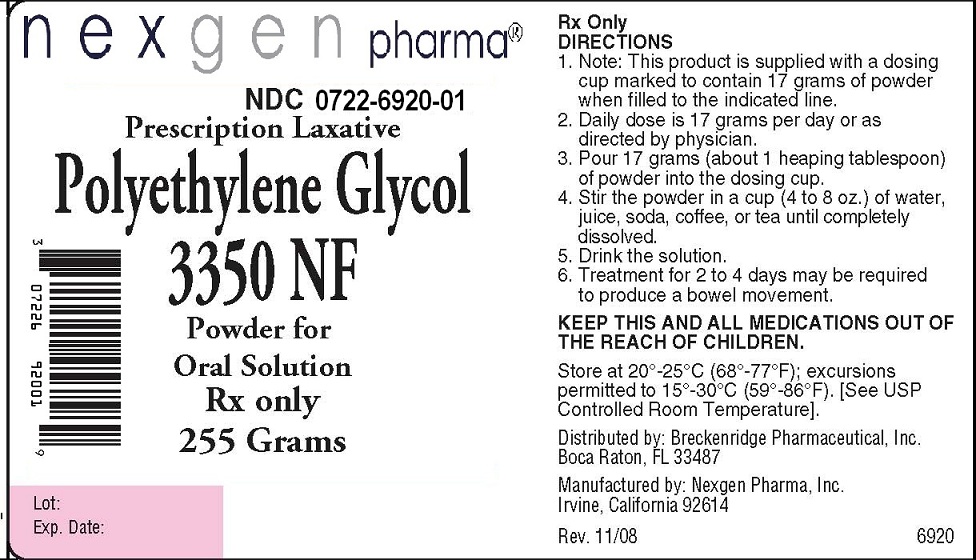
NDC: 0722-6920-01 Polyethylene Glycol 3350 NF 255g
NDC: 0722-6921-01 Polyethylene Glycol 3350 NF 527g
The dosing cup supplied with each bottle is marked with a measuring line and may be used to
measure a single Polyethylene Glycol 3350 NF dose of 17 grams (about 1 heaping tablespoonful).
Rx only
Keep this and all medications out of the reach of children.
STORAGE
Store at 20°- 25°C (68°- 77°F); excursions permitted to 15° - 30°C (59° - 86°F).
[See USP Controlled Room Temperature]
Manufactured by:
Nexgen Pharma, Inc.
Irvine, CA 92614
Distributed by:
Breckenridge Pharmaceutical, Inc.
Boca Raton, FL 33487
6920, 6921 Rev 11/08
-
PATIENT INFORMATION
PATIENT INFORMATION
Polyethylene Glycol 3350 NF (Polyethylene Glycol 3350 Powder for Oral Solution) is a
prescription only laxative which has been prescribed by your physician to treat constipation.
This product should only be used by the person for whom it was prescribed.
How to take
The dose is 17 grams each day or as directed by physician. It should always be taken by mouth.
Measure the dose using the dosing cup (or use one heaping tablespoon of powder), stir and
dissolve in a glass (4 to 8 oz) of water, juice, soda, coffee, or tea. Taking more than the
prescribed dose may cause loss of fluid due to severe diarrhea.
How will it work
Polyethylene Glycol 3350 NF softens the stool and increases the frequency of bowel
movements by retaining water in the stool. Your first bowel movement will usually happen in
two to four days, although results may vary for individual patients.
How long should I take it
Polyethylene Glycol 3350 NF achieves its best results when used between one and two weeks.
You may discontinue taking the drug after you had several satisfactory bowel movements.
Should unusual cramps, bloating, or diarrhea occur, consult your physician. Polyethylene
Glycol 3350 NF is intended for up to a two week course of therapy. You should not use for a
longer time unless directed by your physician.
Next Steps
After successfully completing Polyethylene Glycol 3350 NF therapy (usually between one and
two weeks), please discuss with your physician lifestyle changes which may produce more
regular bowel habits (adequate dietary and fluid intake, regular exercise).
Who should NOT take Polyethylene Glycol 3350 NF
Polyethylene Glycol 3350 NF should not be used by children. It should not be used by pregnant
women unless prescribed by a physician.
Side Effects/Drug Reactions
Occasionally, Polyethylene Glycol 3350 NF may cause nausea, stomach fullness, cramping,
diarrhea and/or gas. Do not take if you have symptoms such as nausea, vomiting, abdominal
pain or distention, which may be due to bowel obstruction. On rare occasions hives and skin
rashes have been reported which are suggestive of an allergic reaction. If you get an allergic
reaction you should discontinue the medication and call your physician. If you are allergic to
polyethylene glycol, do not use this drug.
- PRINCIPAL DISPLAY PANEL
-
INGREDIENTS AND APPEARANCE
POLYETHYLENE GLYCOL 3350
polyethylene glycol 3350 powder, for solutionProduct Information Product Type HUMAN PRESCRIPTION DRUG Item Code (Source) NDC: 0722-6920 Route of Administration ORAL Active Ingredient/Active Moiety Ingredient Name Basis of Strength Strength POLYETHYLENE GLYCOL 3350 (UNII: G2M7P15E5P) (POLYETHYLENE GLYCOL 3350 - UNII:G2M7P15E5P) POLYETHYLENE GLYCOL 3350 17 g Packaging # Item Code Package Description Marketing Start Date Marketing End Date 1 NDC: 0722-6920-01 255 in 1 BOTTLE, PLASTIC Marketing Information Marketing Category Application Number or Monograph Citation Marketing Start Date Marketing End Date ANDA ANDA077706 09/27/2006 Labeler - Nexgen Pharma, Inc. (048488621) Registrant - Nexgen Pharma, Inc. (048488621) Establishment Name Address ID/FEI Business Operations Nexgen Pharma, Inc. 160356114 MANUFACTURE(0722-6920)
© 2026 FDA.report
This site is not affiliated with or endorsed by the FDA.