PROPARACAINE HYDROCHLORIDE- proparacaine hydrochloride solution/ drops
Proparacaine hydrochloride by
Drug Labeling and Warnings
Proparacaine hydrochloride by is a Prescription medication manufactured, distributed, or labeled by Micro Labs Limited. Drug facts, warnings, and ingredients follow.
Drug Details [pdf]
-
DESCRIPTION
Proparacaine hydrochloride ophthalmic solution USP, 0.5% is a local anesthetic for ophthalmic instillation. Each mL of sterile aqueous solution contains active ingredient: proparacaine hydrochloride 5 mg (0.5%) and inactive ingredients: glycerin (tonicity agent), benzalkonium chloride, 0.01% (preservative) and water for injection (vehicle). The pH may be adjusted with hydrochloric acid and/or sodium hydroxide. At the time of manufacture, the air in the container is replaced by nitrogen.
Proparacaine hydrochloride is designated chemically as 2-(Diethylamino) ethyl 3-amino-4-propoxybenzoate monohydrochloride.
Graphic formula:
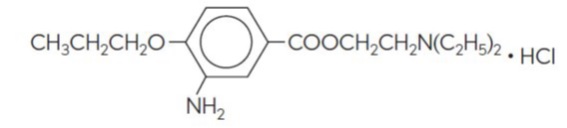
C 16H 26N 2O 3HCl MW 330.85 CAS-5875-06-9
-
CLINICAL PHARMACOLOGY
Proparacaine hydrochloride ophthalmic solution is a rapid acting local anesthetic suitable for ophthalmic use. With a single drop, the onset of anesthesia occurs in approximately 13 seconds and persists for 15 minutes or longer.
The main site of anesthetic action is the nerve cell membrane where proparacaine interferes with the large transient increase in the membrane permeability to sodium ions that is normally produced by a slight depolarization of the membrane. As the anesthetic action progressively develops in a nerve, the threshold for electrical stimulation gradually increases and the safety factor for conduction decreases; when this action is sufficiently well developed, block of conduction is produced.
The exact mechanism whereby proparacaine and other local anesthetics influence the permeability of the cell membrane is unknown; however, several studies indicate that local anesthetics may limit sodium ion permeability by closing the pores through which the ions migrate in the lipid layer of the nerve cell membrane. This limitation prevents the fundamental change necessary for the generation of the action potential.
-
INDICATIONS AND USAGE
Proparacaine Hydrochloride Ophthalmic solution is indicated for topical anesthesia in ophthalmic practice. Representative ophthalmic procedures in which the preparation provides good local anesthesia include measurement of intraocular pressure (tonometry), removal of foreign bodies and sutures from the cornea, conjunctival scraping in diagnosis and gonioscopic examination; it is also indicated for use as a topical anesthetic prior to surgical operations such as cataract extraction.
- CONTRAINDICATIONS
-
WARNINGS
For topical ophthalmic use only.
Prolonged use of a topical ocular anesthetic may produce permanent corneal opacification with accompanying loss of visual.
Proparacaine hydrochloride ophthalmic solution is indicated for administration under the direct supervision of a
healthcare provider. Proparacaine hydrochloride ophthalmic solution is not intended for patient self-administration.
-
PRECAUTIONS
General
Proparacaine should be used cautiously and sparingly in patients with known allergies, cardiac disease, or hyperthyroidism. The long-term toxicity of proparacaine is unknown; prolonged use may possibly delay wound healing. Although exceedingly rare with ophthalmic application of local anesthetics, it should be borne in mind that systemic toxicity (manifested by central nervous system stimulation followed by depression) may occur.
Protection of the eye from irritating chemicals, foreign bodies and rubbing during the period of anesthesia is very important. Tonometers soaked in sterilizing or detergent solutions should be thoroughly rinsed with sterile distilled water prior to use. Patients should be advised to avoid touching the eye until the anesthesia has worn off.
Carcinogenesis, Mutagenesis, Impairment of Fertility
Long-term studies in animals have not been performed to evaluate carcinogenic potential, mutagenicity, or possible impairment of fertility in males or females.
Pregnancy
Animal reproduction studies have not been conducted with proparacaine hydrochloride ophthalmic solution, 0.5%. It is also not known whether proparacaine hydrochloride can cause fetal harm when administered to a pregnant woman or can affect reproduction capacity. Proparacaine hydrochloride should be administered to a pregnant woman only if clearly needed.
Nursing Mothers
It is not known whether this drug is excreted in human milk. Because many drugs are excreted in human milk, caution should be exercised when proparacaine hydrochloride is administered to a nursing woman.
Pediatric Use
Safety and effectiveness of proparacaine hydrochloride ophthalmic solution in pediatric patients have been established. Use of proparacaine hydrochloride is supported by evidence from adequate and well-controlled studies in adults and children over the age of twelve, and safety information in neonates and other pediatric patients.
-
ADVERSE REACTIONS
Pupillary dilation or cycloplegic effects have rarely been observed with proparacaine hydrochloride. The drug appears to be safe for use in patients sensitive to other local anesthetics, but local or systemic sensitivity occasionally occurs.
Instillation of proparacaine in the eye at recommended concentration and dosage usually produces little or no initial irritation, stinging, burning, conjunctival redness, lacrimation or increased winking. However, some local irritation and stinging may occur several hours after the instillation. Rarely, a severe, immediate-type, apparently
hyperallergic corneal reaction may occur which includes acute, intense and diffuse epithelial keratitis; a gray, ground-glass appearance; sloughing of large areas of necrotic epithelium; corneal filaments and, sometimes, iritis with descemetitis. Allergic contact dermatitis with drying and fissuring of the fingertips has been reported.
Softening and erosion of the corneal epithelium and conjunctival congestion and hemorrhage have been reported.
To report SUSPECTED ADVERSE REACTIONS, contactMicro Labs USA, Inc.,at 1-855-839-8195 or FDA at 1-800-FDA-1088 or www.fda.gov/medwatch.
-
DOSAGE AND ADMINISTRATION
Deep anesthesia as in cataract extraction:
Instill 1 drop every 5 to 10 minutes for 5 to 7 doses.
Removal of sutures:
Instill 1 or 2 drops 2 or 3 minutes before removal of stitches.
Removal of foreign bodies:
Instill 1 or 2 drops prior to operating.
Tonometry:
Instill 1 or 2 drops immediately before measurement
-
HOW SUPPLIED
Proparacaine hydrochloride ophthalmic solution USP, 0.5% is supplied in a 3-piece white low density polyethylene S design container with natural low density polyethylene S design open nozzle and white color high density polyethylene S design cap with TSTR- tear off ring.
15 mL fill in 15 mL Container NDC: 42571-497-57
Storage:
Refrigerate at 2° to 8° C. Keep bottle tightly closed. Store bottles in carton until empty to protect from light. If solution shows more than a faint yellow color, it should not be used.
Manufactured by:
Micro Labs Limited
Bangalore-560099, INDIA
Manufactured for:
Micro Labs USA, Inc.
Somerset, NJ 08873
Rev. 01/2025
- MICROBIOLOGY SECTION
-
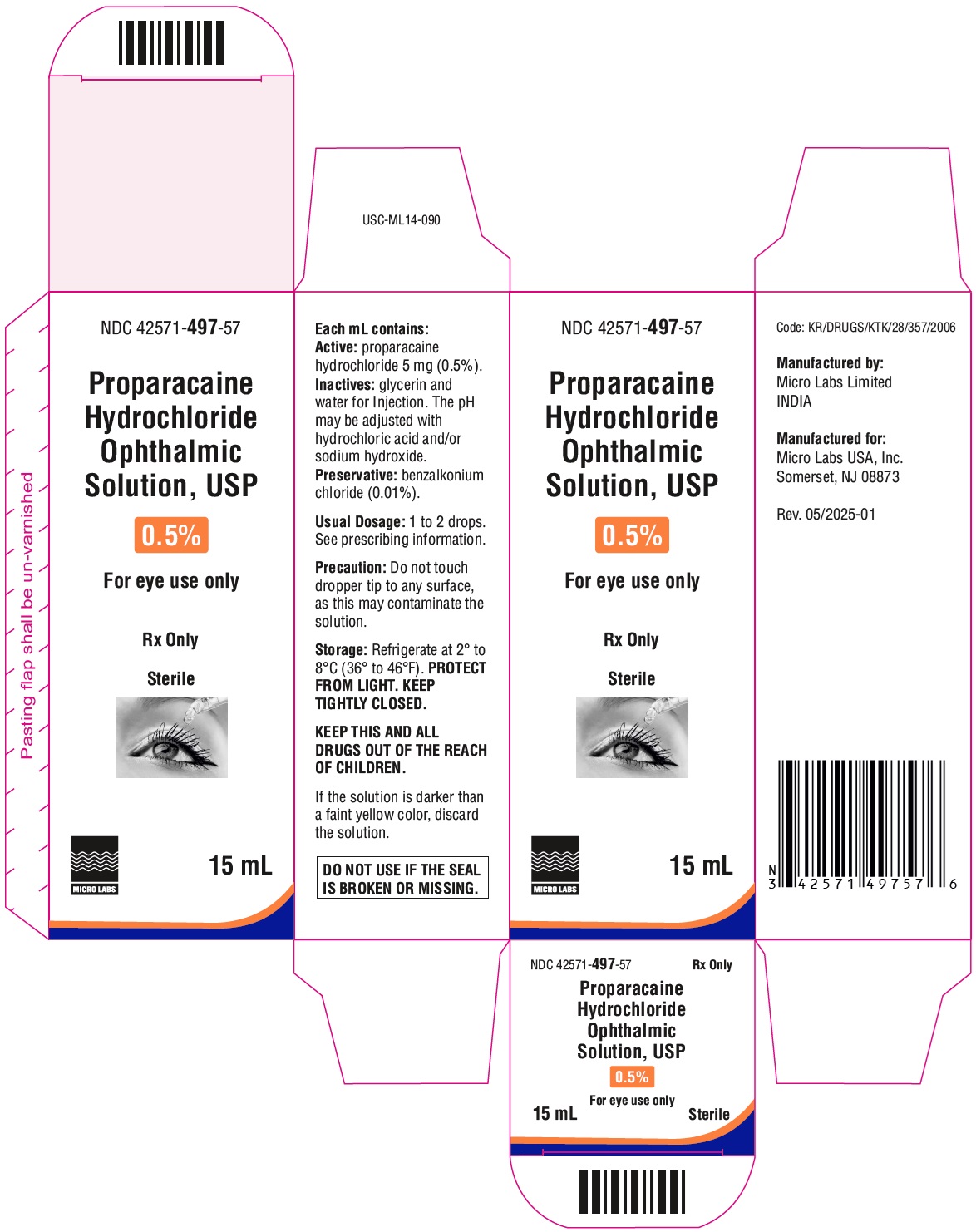
PACKAGE LABEL.PRINCIPAL DISPLAY PANEL
NDC: 42571-497-57
Rx only
Proparacaine Hydrochloride Ophthalmic Solution, USP
0.5%For eye use only
15 mL
Sterile
Micro Labs Limited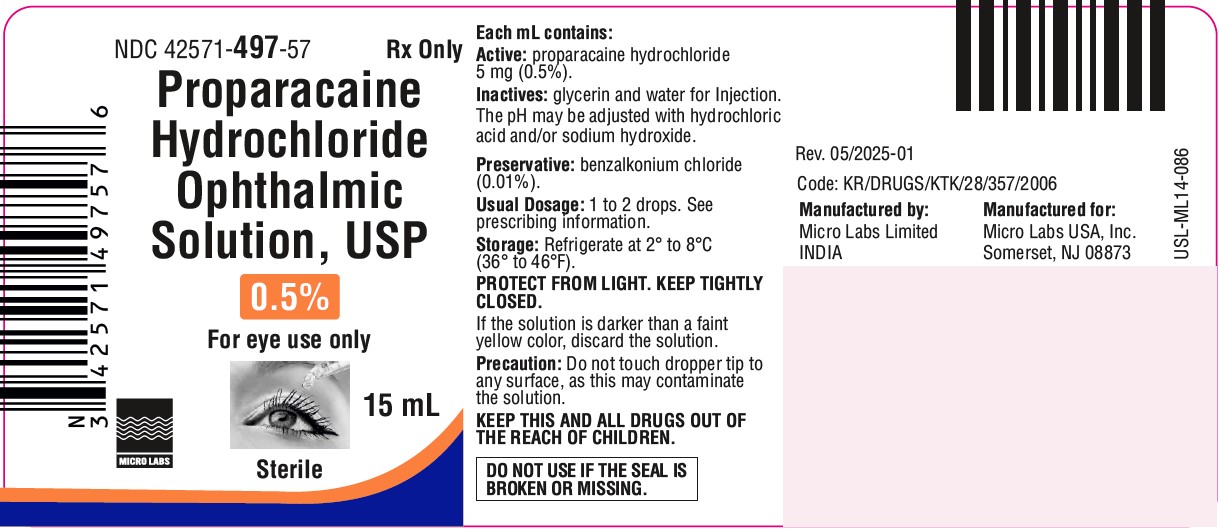
-
INGREDIENTS AND APPEARANCE
PROPARACAINE HYDROCHLORIDE
proparacaine hydrochloride solution/ dropsProduct Information Product Type HUMAN PRESCRIPTION DRUG Item Code (Source) NDC: 42571-497 Route of Administration OPHTHALMIC Active Ingredient/Active Moiety Ingredient Name Basis of Strength Strength PROPARACAINE HYDROCHLORIDE (UNII: U96OL57GOY) (PROPARACAINE - UNII:B4OB0JHI1X) PROPARACAINE HYDROCHLORIDE 5 mg in 1 mL Inactive Ingredients Ingredient Name Strength BENZALKONIUM CHLORIDE (UNII: F5UM2KM3W7) GLYCERIN (UNII: PDC6A3C0OX) HYDROCHLORIC ACID (UNII: QTT17582CB) SODIUM HYDROXIDE (UNII: 55X04QC32I) WATER (UNII: 059QF0KO0R) Packaging # Item Code Package Description Marketing Start Date Marketing End Date 1 NDC: 42571-497-57 1 in 1 CARTON 02/01/2026 1 15 mL in 1 BOTTLE; Type 0: Not a Combination Product Marketing Information Marketing Category Application Number or Monograph Citation Marketing Start Date Marketing End Date ANDA ANDA219294 02/01/2026 Labeler - Micro Labs Limited (862174955) Establishment Name Address ID/FEI Business Operations Micro Labs Limited 677600482 analysis(42571-497) , label(42571-497) , manufacture(42571-497) , pack(42571-497)
© 2026 FDA.report
This site is not affiliated with or endorsed by the FDA.