Ondansetron

Manufacturer
NuCare Pharmaceuticals,Inc.
Effective date
2026-03-13
Label type
HUMAN PRESCRIPTION DRUG LABEL
Version
2
Source
full-release
Hydrated at
2026-05-31 22:09:38

Key Label Information#

Uses

1 INDICATIONS AND USAGE

Ondansetron is indicated for the prevention of nausea and vomiting associated with: highly emetogenic cancer chemotherapy, including cisplatin greater than or equal to 50 mg/m 2 initial and repeat courses of moderately emetogenic cancer chemotherapy radiotherapy in patients receiving either total body irradiation, single high-dose fraction to the abdomen, or daily fractions to the abdomen Ondansetron is also indicated for the prevention of postoperative nausea and/or vomiting.

4 CONTRAINDICATIONS

Ondansetron is contraindicated in patients: known to have hypersensitivity (e.g., anaphylaxis) to ondansetron or any of the components of the formulation [see Adverse Reactions ( 6.2 )] receiving concomitant apomorphine due to the risk of profound hypotension and loss of consciousness

Warnings

4 CONTRAINDICATIONS

Ondansetron is contraindicated in patients: known to have hypersensitivity (e.g., anaphylaxis) to ondansetron or any of the components of the formulation [see Adverse Reactions ( 6.2 )] receiving concomitant apomorphine due to the risk of profound hypotension and loss of consciousness

5 WARNINGS AND PRECAUTIONS

Directions And Dosage

2 DOSAGE AND ADMINISTRATION

3 DOSAGE FORMS AND STRENGTHS

Ondansetron Tablets, USP are oval, standard convex, film-coated tablets and are available in the following strengths: 4 mg - white tablet with ‘4’ on one side and ‘G1’ logo on the other side 8 mg - yellow tablet with ‘8’ on one side and ‘G1’ logo on the other side Ondansetron Orally Disintegrating Tablets, USP are white, circular, flat faced, uncoated tablets and are available in the following strengths: 4 mg - ‘G’ engraved on one side and ‘4’ on the other side 8 mg - ‘G’ engraved on one side and ‘8’ on the other side

10 OVERDOSAGE

There is no specific antidote for ondansetron overdose. Patients should be managed with appropriate supportive therapy. In addition to the adverse reactions listed above, the following adverse reactions have been described in the setting of ondansetron overdose: “Sudden blindness” (amaurosis) of 2 to 3 minutes’ duration plus severe constipation occurred in one patient that was administered 72 mg of ondansetron intravenously as a single dose. Hypotension (and faintness) occurred in a patient that took 48 mg of ondansetron tablets. Following infusion of 32 mg over only a 4-minute period, a vasovagal episode with transient second‑degree heart block was observed. In all instances, the adverse reactions resolved completely. Pediatric cases consistent with serotonin syndrome have been reported after inadvertent oral overdoses of ondansetron (exceeding estimated ingestion of 5 mg per kg) in young children. Reported symptoms included somnolence, agitation, tachycardia, tachypnea, hypertension, flushing, mydriasis, diaphoresis, myoclonic movements, horizontal nystagmus, hyperreflexia, and seizure. Patients required supportive care, including intubation in some cases, with complete recovery without sequelae within 1 to 2 days.

Other Label Information

16 HOW SUPPLIED/STORAGE AND HANDLING

8 mg (as 8 mg ondansetron base) are white, circular, flat faced, uncoated tablets with ‘G’ engraved on one side and ‘8’ on the other side in: Carton of 10 tablets (contains 1 card of 10 unit-of-use blisters) NDC 68071-2718-1 Store at 20°C to 25°C (68°F to 77°F) [see USP Controlled Room Temperature].

PACKAGE/LABEL PRINCIPAL DISPLAY PANEL

Label Images#

structure-hcl
structure-hcl
structure-base
structure-base
logo
logo
68071-2718-1
68071-2718-1

DailyMed RxNorm Mappings#

RxCUI, RxNorm string, TTY table
RxCUIRxNorm stringTTYSPL version
312087ondansetron 8 MG Disintegrating Oral TabletPSN2
312087ondansetron 8 MG Disintegrating Oral TabletSCD2

DailyMed Pharmacologic Classes#

Class, Version, Type table
ClassVersionTypeEffective
ONDANSETRON Pharmacologic Class Indexing2Indexing - Pharmacologic Class20180813

DailyMed Product Concepts#

Product concept, Relation, Version table
Product conceptRelationVersionEffective
d9bd4853-037c-6968-f4d4-9bb9a0efd1eaProduct name220250722
32e23bc9-ce14-4555-bb6d-bcb654d7d296Product name120201015
e459f50a-1553-4aab-b6bd-1e5f0c211c49Product name120201015
909480fe-0d18-c1c1-a658-0bd9a7131822Product name520170829

FDA-Initiated Inactive NDC Indexing#

DailyMed Package Descriptions#

Package NDC, Product, Description table
Package NDCProductDescriptionFormQuantityStrengthSPL version
68071-2718-1Ondansetron10 in 1 BOX, UNIT-DOSETABLET, ORALLY DISINTEGRATING102

DailyMed Billing Units#

Package NDC, Billing unit, Product NDC table
Package NDCBilling unitProduct NDCDailyMed indexing SPLSPL versionEffective
68462-158-11EA - Each68462-15896f07cfc-360f-4c96-9204-ff3d0e491def12012-07-24
68462-158-13EA - Each68462-158dd0a48ed-d8d2-4f34-b6e0-9b9da42240ae12012-07-24

NDC Codes#

Product NDC, Package NDC table
Product NDCPackage NDC
68071-271868071-2718-1
68462-158

Ingredients#

Complete SPL Sections#

1 INDICATIONS AND USAGE

INDICATIONS & USAGE SECTION

Ondansetron is indicated for the prevention of nausea and vomiting associated with: highly emetogenic cancer chemotherapy, including cisplatin greater than or equal to 50 mg/m 2 initial and repeat courses of moderately emetogenic cancer chemotherapy radiotherapy in patients receiving either total body irradiation, single high-dose fraction to the abdomen, or daily fractions to the abdomen Ondansetron is also indicated for the prevention of postoperative nausea and/or vomiting.

2 DOSAGE AND ADMINISTRATION

DOSAGE & ADMINISTRATION SECTION

3 DOSAGE FORMS AND STRENGTHS

DOSAGE FORMS & STRENGTHS SECTION

Ondansetron Tablets, USP are oval, standard convex, film-coated tablets and are available in the following strengths: 4 mg - white tablet with ‘4’ on one side and ‘G1’ logo on the other side 8 mg - yellow tablet with ‘8’ on one side and ‘G1’ logo on the other side Ondansetron Orally Disintegrating Tablets, USP are white, circular, flat faced, uncoated tablets and are available in the following strengths: 4 mg - ‘G’ engraved on one side and ‘4’ on the other side 8 mg - ‘G’ engraved on one side and ‘8’ on the other side

4 CONTRAINDICATIONS

CONTRAINDICATIONS SECTION

Ondansetron is contraindicated in patients: known to have hypersensitivity (e.g., anaphylaxis) to ondansetron or any of the components of the formulation [see Adverse Reactions ( 6.2 )] receiving concomitant apomorphine due to the risk of profound hypotension and loss of consciousness

5 WARNINGS AND PRECAUTIONS

WARNINGS AND PRECAUTIONS SECTION

6 ADVERSE REACTIONS

ADVERSE REACTIONS SECTION

The following clinically significant adverse reactions are described elsewhere in the labeling: Hypersensitivity Reactions [see Warnings and Precautions ( 5.1 )] QT Prolongation [see Warnings and Precautions ( 5.2 )] Serotonin Syndrome [see Warnings and Precautions ( 5.3 )] Myocardial Ischemia [see Warnings and Precautions ( 5.4 )] Masking of Progressive Ileus and Gastric Distension [see Warnings and Precautions ( 5.5 )]

7 DRUG INTERACTIONS

DRUG INTERACTIONS SECTION

8 USE IN SPECIFIC POPULATIONS

USE IN SPECIFIC POPULATIONS SECTION

9 DRUG ABUSE AND DEPENDENCE

DRUG ABUSE AND DEPENDENCE SECTION

Animal studies have shown that ondansetron is not discriminated as a benzodiazepine nor does it substitute for benzodiazepines in direct addiction studies.

10 OVERDOSAGE

OVERDOSAGE SECTION

There is no specific antidote for ondansetron overdose. Patients should be managed with appropriate supportive therapy. In addition to the adverse reactions listed above, the following adverse reactions have been described in the setting of ondansetron overdose: “Sudden blindness” (amaurosis) of 2 to 3 minutes’ duration plus severe constipation occurred in one patient that was administered 72 mg of ondansetron intravenously as a single dose. Hypotension (and faintness) occurred in a patient that took 48 mg of ondansetron tablets. Following infusion of 32 mg over only a 4-minute period, a vasovagal episode with transient second‑degree heart block was observed. In all instances, the adverse reactions resolved completely. Pediatric cases consistent with serotonin syndrome have been reported after inadvertent oral overdoses of ondansetron (exceeding estimated ingestion of 5 mg per kg) in young children. Reported symptoms included somnolence, agitation, tachycardia, tachypnea, hypertension, flushing, mydriasis, diaphoresis, myoclonic movements, horizontal nystagmus, hyperreflexia, and seizure. Patients required supportive care, including intubation in some cases, with complete recovery without sequelae within 1 to 2 days.

11 DESCRIPTION

DESCRIPTION SECTION

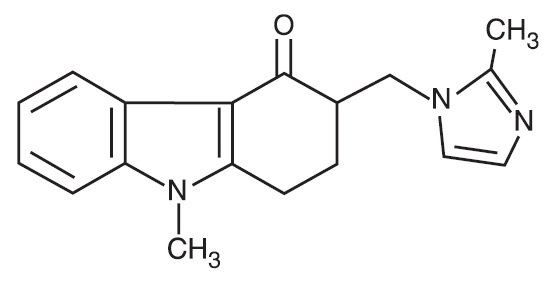
The active ingredient in Ondansetron Tablets, USP is ondansetron hydrochloride, USP as the dihydrate, the racemic form of ondansetron and a selective blocking agent of the serotonin 5-HT 3 receptor type. Chemically it is (±) 1, 2, 3, 9-tetrahydro-9-methyl-3-[(2-methyl-1H-imidazol-1-yl)methyl]-4H-carbazol-4-one, monohydrochloride, dihydrate. It has the following structural formula: The empirical formula is C 18 H 19 N 3 O•HCl•2H 2 O, representing a molecular weight of 365.85 g/mol. Ondansetron hydrochloride, USP (dihydrate) is a white to off-white powder that is sparingly soluble in water and in alcohol; soluble in methanol, slightly soluble in isopropyl alcohol, and in dichloromethane; very slightly soluble in acetone, in chloroform and in ethyl acetate. The active ingredient in Ondansetron Orally Disintegrating Tablets, USP is ondansetron base, the racemic form of ondansetron, and a selective blocking agent of the serotonin 5-HT 3 receptor type. Chemically it is (±) 1, 2, 3, 9-tetrahydro-9-methyl-3-[(2-methyl-1H-imidazol-1-yl)methyl]-4H-carbazol-4-one. It has the following structural formula: The empirical formula is C 18 H 19 N 3 O representing a molecular weight of 293.4 g/mol. Each 4-mg Ondansetron Tablet, USP for oral administration contains ondansetron hydrochloride, USP (dihydrate) equivalent to 4 mg of ondansetron. Each 8-mg Ondansetron Tablet, USP for oral administration contains ondansetron hydrochloride, USP (dihydrate) equivalent to 8 mg of ondansetron. Each tablet also contains the inactive ingredients colloidal silicon dioxide, hypromellose, iron oxide yellow (8 mg tablet only), lactose monohydrate, magnesium stearate, microcrystalline cellulose, pregelatinized starch, titanium dioxide and triacetin. Each 4-mg Ondansetron Orally Disintegrating Tablet, USP for oral administration contains 4 mg ondansetron base. Each 8-mg Ondansetron Orally Disintegrating Tablet, USP for oral administration contains 8 mg ondansetron base. Each Ondansetron Orally Disintegrating Tablet, USP also contains the inactive ingredients aspartame, colloidal silicon dioxide, crospovidone, magnesium stearate, mannitol, sodium stearyl fumarate and strawberry flavor. Ondansetron Orally Disintegrating Tablets, USP are an orally administered formulation of ondansetron which rapidly disintegrates on the tongue and does not require water to aid dissolution or swallowing. This product disintegrates in approximately 60 seconds. Ondansetron Orally Disintegrating Tablets, USP meet USP Disintegration Test 2.

12 CLINICAL PHARMACOLOGY

CLINICAL PHARMACOLOGY SECTION

13 NONCLINICAL TOXICOLOGY

NONCLINICAL TOXICOLOGY SECTION

14 CLINICAL STUDIES

CLINICAL STUDIES SECTION

16 HOW SUPPLIED/STORAGE AND HANDLING

HOW SUPPLIED SECTION

8 mg (as 8 mg ondansetron base) are white, circular, flat faced, uncoated tablets with ‘G’ engraved on one side and ‘8’ on the other side in: Carton of 10 tablets (contains 1 card of 10 unit-of-use blisters) NDC 68071-2718-1 Store at 20°C to 25°C (68°F to 77°F) [see USP Controlled Room Temperature].

17 PATIENT COUNSELING INFORMATION

INFORMATION FOR PATIENTS SECTION

Hypersensitivity Reactions Inform patients that ondansetron may cause hypersensitivity reactions, some as severe as anaphylaxis and bronchospasm. Instruct patients to immediately report any signs and symptoms of hypersensitivity reactions, including fever, chills, rash, or breathing problems to their healthcare provider [ see Warnings and Precautions ( 5.1 ) ]. QT Prolongation Inform patients that ondansetron may cause serious cardiac arrhythmias, such as QT prolongation. Instruct patients to tell their healthcare provider right away if they perceive a change in their heart rate, if they feel lightheaded, or if they have a syncopal episode [ see Warnings and Precautions ( 5.2 ) ]. Drug Interactions Instruct the patient to report the use of all medications, especially apomorphine, to their healthcare provider. Concomitant use of apomorphine and ondansetron may cause a significant drop in blood pressure and loss of consciousness. Advise patients of the possibility of serotonin syndrome with concomitant use of ondansetron and another serotonergic agent, such as medications to treat depression and migraines. Advise patients to seek immediate medical attention if the following symptoms occur: changes in mental status, autonomic instability, neuromuscular symptoms with or without gastrointestinal symptoms [ see Warnings and Precautions ( 5.3 ) ]. Myocardial Ischemia Inform patients that ondansetron may cause myocardial ischemia. Advise patients to seek immediate medical help if any symptoms suggestive of a myocardial ischemia occur, such as sudden chest pain or chest tightness [see Warnings and Precautions ( 5.4 )] . Masking of Progressive Ileus and Gastric Distension Inform patients following abdominal surgery or those with chemotherapy‑induced nausea and vomiting that ondansetron may mask signs and symptoms of bowel obstruction. Instruct patients to immediately report any signs or symptoms consistent with a potential bowel obstruction to their healthcare provider [ see Warnings and Precautions ( 5.5 ) ]. Administration of Ondansetron Orally Disintegrating Tablets Instruct patients not to remove ondansetron orally disintegrating tablets from the blister until just prior to dosing. Do not attempt to push ondansetron orally disintegrating tablets through the foil backing. With dry hands, peel back the foil backing of 1 blister and gently remove the tablet. Immediately place the ondansetron orally disintegrating tablet on top of the tongue where it will dissolve in seconds, then swallow with saliva. Administration with liquid is not necessary. Peelable illustrated stickers are affixed to the product carton that can be provided with the prescription to ensure proper use and handling of the product. Manufactured by: Glenmark Pharmaceuticals Limited India Manufactured for: Glenmark Pharmaceuticals Inc., USA Mahwah, NJ 07430 Questions? 1 (888) 721-7115 www.glenmarkpharma-us.com November 2021

PACKAGE/LABEL PRINCIPAL DISPLAY PANEL

PACKAGE LABEL.PRINCIPAL DISPLAY PANEL

Source Document#

Source XML