Cyproheptadine Hydrochloride Tablets, USP

Manufacturer
QPharma Inc | Rising Pharma Holdings, Inc. | Northwind Pharmaceuticals, LLC
Effective date
2023-03-01
Label type
HUMAN PRESCRIPTION DRUG LABEL
Version
1
Source
legacy-cache
Hydrated at
2026-08-01 21:35:17

Label at a glance#

ProductCyproheptadine Hydrochloride
Active ingredientCYPROHEPTADINE HYDROCHLORIDE
Label structure11 sections

Indications and uses

Perennial and seasonal allergic rhinitis Vasomotor rhinitis Allergic conjunctivitis due to inhalant allergens and foods Mild, uncomplicated allergic skin manifestations of urticaria and angioedema. Amelioration of allergic reactions to blood or plasma Cold urticaria Dermatographism As therapy for anaphylactic reactions adjunctive to epinephrine and other standard measures after the acute manifestations have been c...

Dosage and administration

DOSAGE SHOULD BE INDIVIDUALIZED ACCORDING TO THE NEEDS AND THE RESPONSE OF THE PATIENT. Each tablet contains 4 mg of cyproheptadine hydrochloride. Pediatric Patients Age 2 to 6 years The total daily dosage for pediatric patients may be calculated on the basis of body weight or body area using approximately 0.25 mg/kg/day or 8 mg per square meter of body surface (8 mg/m 2 ). The usual dose is 2 mg (½ tablet) two or...

Label contents#

Full prescribing information#

DESCRIPTION

DESCRIPTION SECTION

Cyproheptadine HCl USP, is an antihistaminic and antiserotonergic agent.

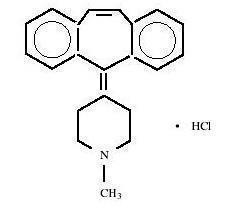
Cyproheptadine hydrochloride USP is a white to slightly yellowish crystalline solid, with a molecular weight of 350.89, which is soluble in water, freely soluble in methanol, sparingly soluble in ethanol, soluble in chloroform, and practically insoluble in ether. It is the sesquihydrate of 4-(5 H-dibenzo [a,d]cyclohepten-5-ylidene)-1-methylpiperidine hydrochloride. The molecular formula of the anhydrous salt is C 21H 21N•HCl and the structural formula of the anhydrous salt is:

structure.jpgstructure.jpg

C 21H 21N• HCl M.W. 350.89

Cyproheptadine hydrochloride USP is available for oral administration in 4 mg tablets. Inactive ingredients include: lactose monohydrate, magnesium stearate, microcrystalline cellulose, and sodium starch glycolate.

CLINICAL PHARMACOLOGY

CLINICAL PHARMACOLOGY SECTION

Cyproheptadine is a serotonin and histamine antagonist with anticholinergic and sedative effects. Antiserotonin and antihistamine drugs appear to compete with serotonin and histamine, respectively, for receptor sites.

Pharmacokinetics and Metabolism

PHARMACOKINETICS SECTION

After a single 4 mg oral dose of 14C-labelled cyproheptadine HCl in normal subjects, given as tablets, 2 to 20% of the radioactivity was excreted in the stools. Only about 34% of the stool radioactivity was unchanged drug, corresponding to less than 5.7% of the dose. At least 40% of the administered radioactivity was excreted in the urine. No detectable amounts of unchanged drug were present in the urine of patients on chronic 12 to 20 mg daily doses. The principle metabolite found in human urine has been identified as a quaternary ammonium glucuronide conjugate of cyproheptadine. Elimination is diminished in renal insufficiency.

INDICATIONS AND USAGE

INDICATIONS & USAGE SECTION

Perennial and seasonal allergic rhinitis

Vasomotor rhinitis

Allergic conjunctivitis due to inhalant allergens and foods

Mild, uncomplicated allergic skin manifestations of urticaria and angioedema.

Amelioration of allergic reactions to blood or plasma

Cold urticaria

Dermatographism

As therapy for anaphylactic reactions adjunctive to epinephrine and other standard measures after the acute manifestations have been controlled.

CONTRAINDICATIONS

CONTRAINDICATIONS SECTION

Newborn or Premature Infants

This drug should not be used in newborn or premature infants.

Nursing Mothers

Because of the higher risk of antihistamines for infants generally and for newborns and prematures in particular, antihistamine therapy is contraindicated in nursing mothers.

Other Conditions

Hypersensitivity to cyproheptadine and other drugs of similar chemical structure.

Monoamine oxidase inhibitor therapy (See DRUG INTERACTIONS.)

Angle-closure glaucoma

Stenosing peptic ulcer

Symptomatic prostatic hypertrophy

Bladder neck obstruction

Pyloroduodenal obstruction

Elderly, debilitated patients

WARNINGS

WARNINGS SECTION

Pediatric Patients

Overdosage of antihistamines, particularly in infants and young children, may produce hallucinations, central nervous system depression, convulsions, respiratory and cardiac arrest, and death.

Antihistamines may diminish mental alertness; conversely, particularly, in the young child, they may occasionally produce excitation.

CNS Depressants

Antihistamines may have additive effects with alcohol and other CNS depressants, e.g., hypnotics, sedatives, tranquilizers, antianxiety agents.

Activities Requiring Mental Alertness

Patients should be warned about engaging in activities requiring mental alertness and motor coordination, such as driving a car or operating machinery.

Antihistamines are more likely to cause dizziness, sedation, and hypotension in elderly patients (see PRECAUTIONS, Geriatric Use).

PRECAUTIONS

PRECAUTIONS SECTION

General

Cyproheptadine has an atropine-like action and, therefore, should be used with caution in patients with:

History of bronchial asthma

Increased intraocular pressure

Hyperthyroidism

Cardiovascular disease

Hypertension

Information for Patients

Antihistamines may diminish mental alertness; conversely, particularly, in the young child, they may occasionally produce excitation. Patients should be warned about engaging in activities requiring mental alertness and motor coordination, such as driving a car or operating machinery.

Drug Interactions

MAO inhibitors prolong and intensify the anticholinergic effects of antihistamines.

Antihistamines may have additive effects with alcohol and other CNS depressants, e.g., hypnotics, sedatives, tranquilizers, antianxiety agents.

Carcinogenesis, Mutagenesis, Impairment of Fertility

Long-term carcinogenic studies have not been done with cyproheptadine.

Cyproheptadine had no effect on fertility in a two-litter study in rats or a two generation study in mice at about 10 times the human dose.

Cyproheptadine did not produce chromosome damage in human lymphocytes or fibroblasts invitro; high doses (10-4M) were cytotoxic. Cyproheptadine did not have any mutagenic effect in the Ames microbial mutagen test; concentrations of above 500 mcg/plate inhibited bacterial growth.

Pregnancy

Pregnancy Category B

Reproduction studies have been performed in rabbits, mice, and rats at oral or subcutaneous doses up to 32 times the maximum recommended human oral dose and have revealed no evidence of impaired fertility or harm to the fetus due to cyproheptadine. Cyproheptadine has been shown to be fetotoxic in rats when given by intraperitoneal injection in doses four times the maximum recommended human oral dose. Two studies in pregnant women, however, have not shown that cyproheptadine increases the risk of abnormalities when administered during the first, second and third trimesters of pregnancy. No teratogenic effects were observed in any of the newborns. Nevertheless, because the studies in humans cannot rule out the possibility of harm, cyproheptadine should be used during pregnancy only if clearly needed.

Nursing Mothers

It is not known whether this drug is excreted in human milk. Because many drugs are excreted in human milk, and because of the potential for serious adverse reactions in nursing infants from cyproheptadine, a decision should be made whether to discontinue nursing or to discontinue the drug, taking into account the importance of the drug to the mother (see CONTRAINDICATIONS).

Pediatric Use

Safety and effectiveness in pediatric patients below the age of two have not been established (see CONTRAINDICATIONS, Newborn or Premature Infants, and WARNINGS,Pediatric Patients).

Geriatric Use

Clinical studies of cyproheptadine HCl tablets did not include sufficient numbers of subjects aged 65 and over to determine whether they respond differently from younger subjects. Other reported clinical experience has not identified differences in responses between the elderly and younger patients. In general, dose selection for an elderly patient should be cautious, usually starting at the low end of the dosing range, reflecting the greater frequency of decreased hepatic, renal, or cardiac function, and of concomitant disease or other drug therapy (see WARNINGS, Activities Requiring Mental Alertness).

ADVERSE REACTIONS

ADVERSE REACTIONS SECTION

Adverse reactions which have been reported with the use of antihistamines are as follows:

Central Nervous System

Sedation and sleepiness (often transient), dizziness, disturbed coordination, confusion, restlessness, excitation, nervousness, tremor, irritability, insomnia, paresthesias, neuritis, convulsions, euphoria, hallucinations, hysteria, faintness.

Integumentary

Allergic manifestation of rash and edema, excessive perspiration, urticaria, photosensitivity.

Special Senses

Acute labyrinthitis, blurred vision, diplopia, vertigo, tinnitus.

Cardiovascular

Hypotension, palpitation, tachycardia, extrasystoles, anaphylactic shock.

Hematologic

Hemolytic anemia, leukopenia, agranulocytosis, thrombocytopenia.

Digestive System

Cholestasis, hepatic failure, hepatitis, hepatic function abnormality, dryness of mouth, epigastric distress, anorexia, nausea, vomiting, diarrhea, constipation, jaundice.

Genitourinary

Urinary frequency, difficult urination, urinary retention, early menses.

Respiratory

Dryness of nose and throat, thickening of bronchial secretions, tightness of chest and wheezing, nasal stuffiness.

Miscellaneous

Fatigue, chills, headache, increased appetite/weight gain.

To report SUSPECTED ADVERESE REACTIONS, contact Rising Pharma Holdings, Inc. at 1-844-874-7464, or FDA at 1-800-FDA-1088 or www.fda.gov/medwatch.

OVERDOSAGE

OVERDOSAGE SECTION

Antihistamine overdosage reactions may vary from central nervous system depression to stimulation especially in pediatric patients. Also, atropine-like signs and symptoms (dry mouth; fixed, dilated pupils; flushing, etc.) as well as gastrointestinal symptoms may occur.

If vomiting has not occurred spontaneously, the patient should be induced to vomit with syrup of ipecac.

If patient is unable to vomit, perform gastric lavage followed by activated charcoal. Isotonic or ½ isotonic saline is the lavage of choice. Precautions against aspiration must be taken especially in infants and children.

When life threatening CNS signs and symptoms are present, intravenous physostigmine salicylate may be considered. Dosage and frequency of administration are dependent on age, clinical response, and recurrence after response. (See package circulars for physostigmine products.)

Saline cathartics, as milk of magnesia, by osmosis draw water into the bowel and, therefore, are valuable for their action in rapid dilution of bowel content.

Stimulants should not be used.

Vasopressors may be used to treat hypotension.

The oral LD 50 of cyproheptadine is 123 mg/kg, and 295 mg/kg in the mouse and rat, respectively

DOSAGE AND ADMINISTRATION

DOSAGE & ADMINISTRATION SECTION

DOSAGE SHOULD BE INDIVIDUALIZED ACCORDING TO THE NEEDS AND THE RESPONSE OF THE PATIENT.

Each tablet contains 4 mg of cyproheptadine hydrochloride.

Pediatric Patients

Age 2 to 6 years

The total daily dosage for pediatric patients may be calculated on the basis of body weight or body area using approximately 0.25 mg/kg/day or 8 mg per square meter of body surface (8 mg/m 2).

The usual dose is 2 mg (½ tablet) two or three times a day, adjusted as necessary to the size and response of the patient. The dose is not to exceed 12 mg a day.

Age 7 to 14 years

The usual dose is 4 mg (1 tablet) two or three times a day adjusted as necessary to the size and response of the patient. The dose is not to exceed 16 mg a day.

Adults

The total daily dose for adults should not exceed 0.5 mg/kg/day. The therapeutic range is 4 to 20 mg a day, with the majority of patients requiring 12 to 16 mg a day. An occasional patient may require as much as 32 mg a day for adequate relief. It is suggested that dosage be initiated with 4 mg (1 tablet) three times a day and adjusted according to the size and response of the patient.

HOW SUPPLIED

HOW SUPPLIED SECTION

Cyproheptadine Hydrochloride Tablets USP, 4 mg are available as white to off-white round convex tablets, engraved IT above bisect and 68 below bisect on one side with other side is plain, containing 4 mg of cyproheptadine HCl packaged in bottles of 21 tablets (NDC 42708-156-21).

PHARMACIST: Dispense in a well-closed container as defined in the USP, with a child-resistant closure (as required).

Store at 20° to 25°C (68° to 77°F) [See USP Controlled Room Temperature].

Distributed by:

Rising Pharma Holdings, Inc.

East Brunswick, NJ 08816

Rev. 08/2021

Principal Display Panel

PACKAGE LABEL.PRINCIPAL DISPLAY PANEL

NDC: 42708-156-21

LabelLabel

DailyMed Billing Units#

Package NDC, Billing unit, Product NDC table
Package NDCBilling unitProduct NDCDailyMed indexing SPLSPL versionEffective
16571-805-01EA - Each16571-805d1f7f490-b670-4f5d-91e0-889e71d5691e12022-03-09
16571-805-10EA - Each16571-805b53c9dd5-b136-4c23-94b8-c083f63f900312023-04-07

Products#

Every source-derived product name is available through these pages.

DailyMed product names page 1 of 1 · 6 matching rows.

NDC Codes#

Product NDC, Package NDC table
Product NDCPackage NDC
42708-15642708-156-21
16571-805

Ingredients#

Every source-derived ingredient row is available through these pages.

DailyMed ingredient rows page 1 of 1 · 5 matching rows.

Source Document#

Source XML

Orange Book application contexts#

All distinct exact application/product contexts derived from this label’s complete NDC list are paginated below.

Orange Book application contexts page 1 of 1 · 1 matching rows.

Source provenance: Browse the complete Orange Book source catalog · source snapshot 1.

Orange Book products#

Current product rows page 1 of 1 · 1 matching rows.

Application-product, Trade name, Ingredient table
Application-productTrade nameIngredientStrengthDosage form / routeTE codesRLD / RSApproval date
A207555-001CYPROHEPTADINE HYDROCHLORIDECYPROHEPTADINE HYDROCHLORIDE4MGTABLET / ORALAA2017-01-31

Therapeutic equivalence codes#

Current TE-code rows page 1 of 1 · 1 matching rows.

Application-product, TE code table
Application-productTE code
A207555-001AA

Observed Orange Book product history#

Observed FDA ZIP history: Each table is queried independently by exact application/product key from successfully parsed Orange Book snapshots. Capture times identify archived source observations; absence or a change between snapshots is not inferred. FDA publication files that were not recoverable as structured ZIP data are not represented as states.

Captured, Edition, Application-product table
CapturedEditionApplication-productTrade nameStrengthDosage form / routeProduct TE source textRLD / RSApproval dateSource SHA-256
2026-08-01 22:54:322026-06A207555-001CYPROHEPTADINE HYDROCHLORIDE4MGTABLET / ORALAA2017-01-31a50c72e98297…

Observed Orange Book normalized TE history#

Captured, Edition, Application-product table
CapturedEditionApplication-productTE codeOrderSource SHA-256
2026-08-01 22:54:322026-06A207555-001AA1a50c72e98297…

openFDA label cross-check#

Cross-check layer: openFDA label JSON enriches search and identifies hydration gaps. The DailyMed Structured Product Label remains the canonical label presentation on FDA.report. Every label matching the complete exact-identifier union is deduplicated and paginated below.

Matched openFDA labels page 1 of 1 · 2 matching rows.

Brand, Generic, Manufacturer table
BrandGenericManufacturerSPL set IDEffective dateAvailable safety fieldsJoin
0c51dfc1-f8bb-2a95-e063-6294a90ad78ff5dcdcce-e66d-b6f6-e053-2995a90aa4b72023-12-08Warnings, Adverse reactionsExact identifier
spl set id: f5dcdcce-e66d-b6f6-e053-2995a90aa4b7
Cyproheptadine HydrochlorideCYPROHEPTADINE HYDROCHLORIDERising Pharma Holdings, Inc.c5e9e983-d0d2-4f87-beae-0d853ca439832022-02-08Warnings, Adverse reactionsExact identifier
ndc (product): 16571-805