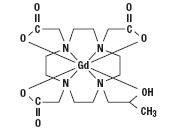
The pharmacokinetics of intravenously
administered gadoteridol in normal subjects conforms to a two-compartment
open model.
Distribution
After intravenous administration,
gadoteridol is rapidly distributed in the extracellular space. The
plasma distribution volume (mean ± SD) for the non-renally impaired
adults was 0.205 ± 0.025 L/kg. It is unknown if protein binding of
gadoteridol occurs in vivo.
Following GBCA administration, gadolinium
is present for months or years in brain, bone, skin, and other organs [see Warnings and Precautions (5.4)].
Metabolism
It is unknown if biotransformation
or decomposition of gadoteridol occur in vivo.
Elimination
Gadoteridol is eliminated unchanged via the kidneys.
The elimination half-life (mean ± SD) is about 1.57 ± 0.08 hours.
Within 24 hours post-injection, 94.4 ± 4.8% of the dose is excreted
in the urine. The renal and plasma clearance rates (1.41 ± 0.33 mL/
min/kg and 1.50 ± 0.35 mL/ min/kg, respectively) of gadoteridol are
essentially identical, indicating no alteration in elimination kinetics
on passage through the kidneys and that the drug is essentially cleared
through the kidney. The volume of distribution (204 ± 58 mL/kg) is
equal to that of extracellular water, and clearance is similar to
that of substances which are subject to glomerular filtration.
Specific Populations
Gender
Gender has no clinically
relevant effect on the pharmacokinetics of gadoteridol.
Geriatric
There were 7 elderly subjects receiving 0.1 (n = 3) and 0.3 mmol/kg
(n = 4) dose of ProHance. The clearance was slightly lower in elderly
subjects as compared to non-elderly subjects. [see Use in
Specific Populations (8.5)].
Pediatric
A population pharmacokinetic analysis incorporated data
from 79 subjects, 45 males and 34 females. Among 79 subjects, 41 were
healthy subjects including 28 pediatric subjects between 5 years and
15 years of age. The pediatric subjects received a single intravenous
dose of 0.1 mmol/kg of ProHance. From population PK model, the mean
Cmax was 0.66 ± 0.21 mmol/L in pediatric subjects
2 years to 6 years of age, 0.58 ± 0.06 mmol/L in pediatric subjects
6 years to 12 years of age, and 0.68 ± 0.12 mmol/L in adolescent subjects
older than 12 years. The mean AUC 0-∞ was 0.74
± 0.20 mmol/L⋅h in pediatric subjects 2 years to 6 years of age, 0.74
± 0.09 mmol/L⋅h in pediatric subjects 6 years to 12 years of age,
and 0.98 ± 0.09 mmol/L⋅h in adolescent subjects older than 12 years
of age. The mean distribution half- life (t1/2,alpha) was 0.14 ± 0.04 hours in pediatric subjects 2 years to 6 years
of age, 0.18 ± 0.07 hours in pediatric subjects 6 years to 12 years
of age, and 0.20 ± 0.07 hours in adolescent subjects older than 12
years of age. The mean elimination half-life (t1/2,beta) was 1.32 ± 0.006 hours in pediatric subjects 2 years to 6 years,
1.32 ± 0.07 hours in pediatric subjects 6 years to 12 years of age,
and 1.61 ± 0.19 hours in adolescent subjects older than 12 years of
age. There was no significant gender-related difference in the pharmacokinetic
parameters in the pediatric patients. Over 80% of the dose was recovered
in urine for pediatric subjects after 10 hours. Pharmacokinetic simulations
indicate similar half-life, AUC, and Cmax values
for ProHance in pediatric subjects less than 2 years of age when compared
to those reported for adults; no age-based dose adjustment is necessary
for this pediatric population.
Renal Impairment
In patients with impaired renal function, the serum half-life of
gadoteridol is prolonged. After intravenous injection of 0.1 mmol/kg,
the elimination half-life of gadoteridol was 10.65 ± 0.60 hours in
mild to moderately impaired patients (creatinine clearance 30 to 60
mL/min) and 9.10±0.26 hours in severely impaired patients not on dialysis
(creatinine clearance 10 to 30 mL/min). The mean serum clearance of
gadoteridol in patients with normal renal function was 116.14 ± 26.77
mL/min, compared to 37.2 ± 16.4 mL/min in patients with mild to moderate
renal impairment and 16.0 ± 3.0 mL/min in patients with severe renal
impairment.
In patients
with moderately and severely impaired renal function about 97% and
76% of the administered dose was recovered in the urine within 7 days
and 14 days, respectively.
For patients receiving hemodialysis, physicians
may consider the prompt initiation of hemodialysis following the administration
of ProHance in order to enhance the contrast agent’s elimination.
Seventy- two percent (72%) of gadoteridol is removed from the body
after the first dialysis, 91% after the second dialysis, and 98% after
the third dialysis session. [See Warnings and Precautions
(5.2) and Use in Specific Populations
(8.6).]